
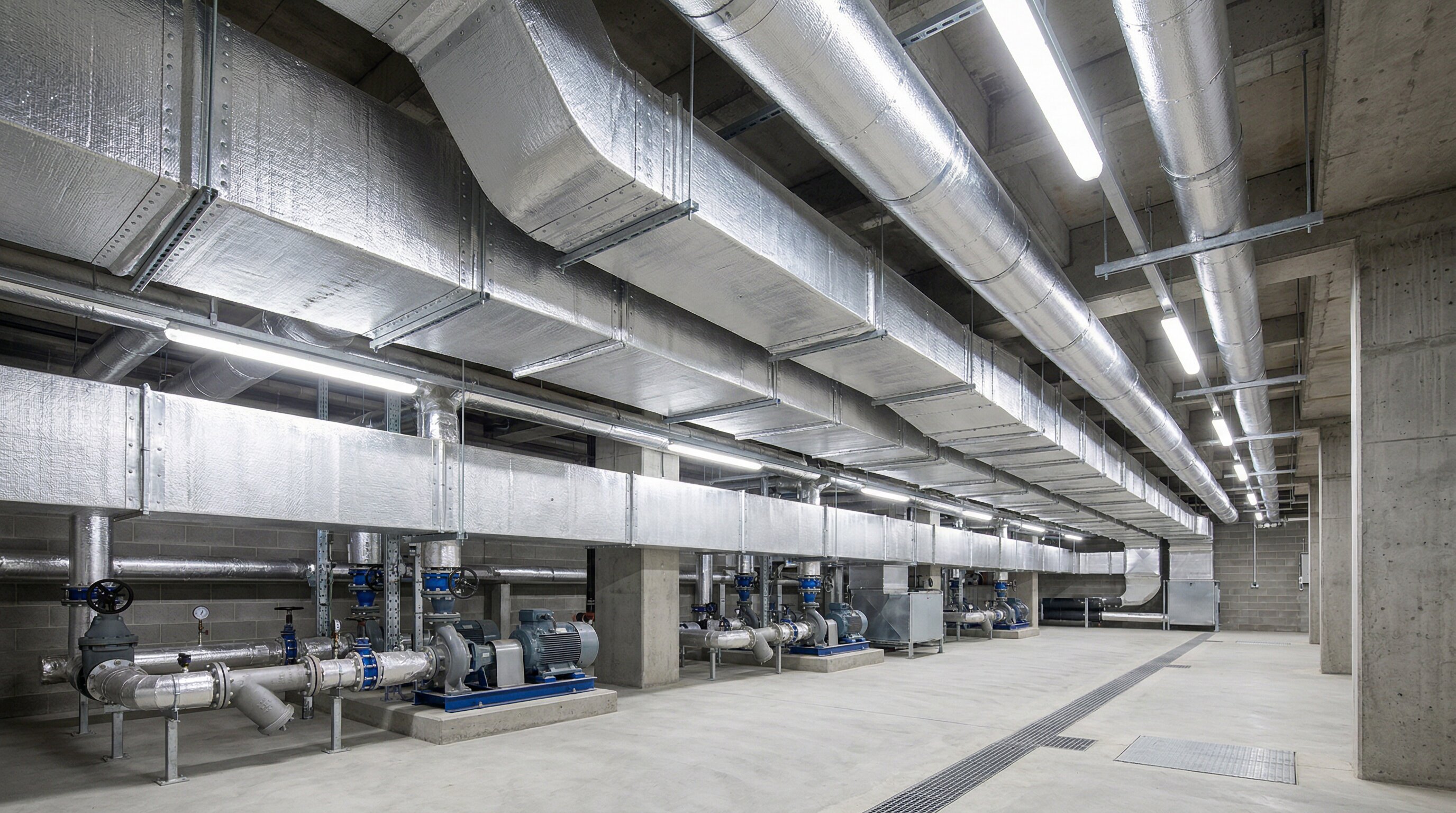
Mechanical plant rooms are the beating heart of any modern commercial building. They house the pumps, fans, chillers, boilers, and air handling units that keep occupied spaces heated, cooled, and ventilated. But that equipment generates significant noise — and in buildings where patient rooms sit above a plant room, hotel guests sleep beside a riser shaft, or office workers concentrate next to a duct route, that noise becomes a serious problem. Acoustic insulation is the primary means of controlling it, and in our experience across hospitals, hotels, data centres, and commercial buildings throughout Dublin and Leinster, it is one of the most frequently underspecified aspects of a mechanical services installation.
Why Plant Room Noise Is a Growing Concern
The issue is not new, but it is getting worse. Modern commercial buildings are increasingly compact, with plant rooms positioned centrally rather than isolated on rooftops or in basements. Mixed-use developments place residential apartments directly above commercial plant, and healthcare facilities routinely stack wards above and below mechanical floors. At the same time, building occupants — patients, hotel guests, students, office workers — expect quiet environments. Acoustic performance is now a core part of building design, and the insulation contractor plays a critical role in delivering it.
Sources of Noise in Mechanical Plant Rooms
Understanding what generates noise in a plant room is essential to treating it properly. The primary sources include:
- Pumps — generate both airborne noise from the motor and casing, and structure-borne vibration that transmits through connected pipework and the building structure
- Fans and air handling units (AHUs) — the largest single noise source in most plant rooms, generating broadband noise from the fan motor, impeller, and airflow across internal components
- Chillers — compressor noise from scroll, screw, or centrifugal chillers, particularly at part-load conditions where tonal noise can be pronounced
- Boilers — combustion noise from gas-fired boilers, fan-assisted burners, and the associated flue systems
- Pipework vibration — water flowing through pipes, particularly at changes in direction and through valves, creates turbulent flow noise that radiates from the pipe wall
- Ductwork turbulence — air moving through rectangular and circular ductwork generates noise at bends, dampers, branch take-offs, and grille connections, which radiates through the duct wall as breakout noise
In a typical commercial plant room, noise levels can reach 85–95 dB(A) during normal operation. Without proper treatment, that noise transmits readily to adjacent occupied spaces.
How Noise Travels from Plant Rooms
Noise from mechanical plant rooms reaches occupied spaces through three principal paths, and an effective strategy must address all three.
Airborne Noise
Sound energy radiates directly from equipment and passes through walls, floors, ceilings, and any penetrations. Even small gaps around pipe and duct penetrations through plant room walls allow significant noise breakout. A 1% open area in a barrier can reduce its effective sound insulation by up to 10 dB — which is why sealing around penetrations is just as important as the insulation on the services themselves.
Structure-Borne Noise
Vibration from rotating equipment, pumps, and fluid flow transmits through pipe hangers, duct supports, equipment mounts, and the building frame. Structure-borne noise can travel long distances through steel and concrete with very little loss, re-radiating as audible noise in rooms far from the plant room. We have seen vibration from a basement pump transmit through steel hangers to cause noise complaints on the third floor above.
Breakout Noise from Ductwork
Ductwork carrying supply or return air acts as a conduit for noise. The sheet metal walls vibrate in response to internal sound pressure and airflow turbulence, radiating noise outwards. This breakout noise is particularly significant on large rectangular ductwork with flat panel sides, which vibrate more readily than circular sections. It is one of the most common acoustic complaints in commercial buildings.
Irish Regulations and Standards
In Ireland, the primary regulation governing sound in buildings is S.I. No. 600/2017 — Building Regulations (Part E – Sound). Part E sets requirements for sound insulation between dwellings and other parts of a building, including mechanical plant areas. While focused primarily on residential separating construction, it establishes the principle that occupants are entitled to reasonable protection from noise — and in practice, this extends to mechanical services noise in mixed-use developments.
For specific guidance on acceptable indoor noise levels, the industry relies on BS 8233:2014 — Guidance on Sound Insulation and Noise Reduction for Buildings. This standard sets recommended indoor ambient noise levels used by acoustic consultants and building services engineers when specifying plant room insulation.
Bedrooms: 30–35 dB LAeq during daytime, 30 dB LAeq at night. Living rooms: 35 dB LAeq. Offices (open-plan): 40–45 dB LAeq. Hospitals (wards): 35 dB LAeq during daytime, 30 dB LAeq at night. Hotel bedrooms: 30–35 dB LAeq. These targets drive the acoustic insulation specification for any ductwork, pipework, or equipment serving spaces above, below, or adjacent to mechanical plant rooms.
In practice, acoustic consultants on Irish projects specify noise rating (NR) curves or dB(A) limits for each occupied room, and the mechanical and insulation contractors must ensure the installed systems meet those targets. For a hospital ward directly above a plant room, a typical target might be NR 30 — which is extremely quiet and demands comprehensive acoustic treatment.
Acoustic Insulation Materials and Methods
There is no single product that solves every acoustic problem in a plant room. Effective noise control requires a combination of materials and methods, selected based on the noise sources, transmission paths, and target levels.
Mineral Wool Wrapping on Ductwork
Mineral wool — whether rock wool or glass mineral wool — is the primary acoustic insulation material used on ductwork. Its fibrous, open structure is inherently excellent at absorbing sound energy. When wrapped around ductwork at 50mm or 75mm thickness, it significantly reduces breakout noise from the duct casing.
Sound energy passing through the duct wall enters the mineral wool, where it is converted to heat through friction within the fibres. The denser and thicker the mineral wool, the greater the absorption — particularly at the low frequencies (125–500 Hz) characteristic of fan noise. The insulation is finished with aluminium foil-backed jacket or sheet cladding, which also adds mass to the system.
Acoustic Lagging on Pipework
Pipework carrying chilled water, heating water, or condensate generates noise from flow turbulence, pump pulsation, and valve noise. A typical acoustic lagging system consists of mineral wool insulation directly on the pipe, a mass-loaded vinyl (MLV) barrier layer, and an outer aluminium jacket. The mineral wool absorbs sound, the MLV blocks transmission through mass, and the aluminium cladding protects the system. For high-noise applications — such as pipework downstream of pressure-reducing valves — the specification may call for thicker insulation or heavier MLV.
Mass-Loaded Vinyl Barriers
Mass-loaded vinyl (MLV) is a dense, flexible sheet material — typically 5 kg/m² or heavier — used as a sound barrier within acoustic insulation systems. It works on the mass law principle: the heavier the barrier, the more effectively it blocks sound. MLV must be combined with an absorptive layer (mineral wool) to be effective. Used alone, it can worsen certain resonance effects. The combination of absorption plus mass barrier is the foundation of most acoustic lagging systems.
Vibration Isolation at Pipe Hangers and Equipment Mounts
Acoustic insulation on pipework and ductwork will not solve noise caused by structure-borne vibration. Vibration must be intercepted at its transmission point — equipment isolated on anti-vibration mounts, pipework supported on vibration-isolating hangers rather than rigid brackets. Spring hangers, rubber-in-shear mounts, and neoprene-lined clamps are standard solutions. We have seen specifications that address airborne noise perfectly, only for the building to fail because pipework was hung off rigid threaded rod directly into the slab above.
Double-Skin Ductwork with Acoustic Infill
For the most demanding applications — ductwork adjacent to hospital wards or noise-sensitive spaces — double-skin ductwork provides the highest level of breakout noise control. An inner and outer metal skin with the cavity filled with acoustic mineral wool provides significant mass, absorption, and decoupling, achieving breakout reductions of 20–30 dB compared to single-skin duct. It is substantially more expensive and is typically specified only where external acoustic lagging alone cannot meet the required targets.
The Dual Benefit: Acoustic and Thermal Performance
One of the most practical advantages of acoustic insulation is that it frequently delivers thermal insulation as well. Mineral wool is also an excellent thermal insulator. When we wrap ductwork with 50mm or 75mm mineral wool for acoustic purposes, that same insulation reduces heat gain or loss from the duct, improving energy efficiency.
Similarly, acoustic lagging on chilled water pipework provides condensation control and thermal performance alongside noise reduction. For building owners, this is an important point: acoustic insulation is not a separate cost layered on top of thermal insulation. In many cases, both requirements can be met with one properly specified system.
Applications: Where Acoustic Insulation Matters Most
Acoustic insulation in mechanical plant rooms is relevant across virtually every building type, but certain applications demand particular attention.
Hospitals and Healthcare Facilities
Patient wards, recovery rooms, and ICUs frequently sit directly above or below mechanical plant floors. The noise targets are stringent — typically NR 25–35 — and the consequences of failure are significant. We have worked on hospital projects in Dublin where the plant room occupied an entire intermediate floor, with patient rooms directly above and below, requiring comprehensive acoustic lagging on every duct and pipe route leaving the plant room.
Hotels
Guest rooms are particularly sensitive to mechanical noise at night when background levels drop while plant equipment continues to operate. Ductwork in ceiling voids, risers adjacent to bedrooms, and plant rooms serving rooftop amenity spaces all require careful treatment. A guest who can hear a low-frequency hum from the chiller plant will not return — and in the era of online reviews, that matters commercially.
Offices
Video calls and hybrid meetings now require lower background noise levels than the traditional open-plan office could tolerate. Ductwork serving office floors must be acoustically treated to meet BS 8233 guidance of 40–45 dB LAeq for open-plan offices and 35–40 dB LAeq for meeting rooms.
Residential Apartments
Mixed-use developments with apartments above commercial plant rooms present some of the most challenging requirements. The combination of Part E requirements for sound insulation between dwellings and non-dwelling spaces, together with BS 8233 guidance for bedrooms and living rooms, demands a robust insulation strategy on all services penetrating the separating floor.
Schools and Universities
Classrooms and lecture theatres require controlled acoustic environments for speech intelligibility. In Ireland, with increasing emphasis on mechanical ventilation in schools following pandemic-era guidance, acoustic insulation on ductwork has become a more prominent part of the specification — typically targeting below NR 30–35 for teaching spaces.
At Alumitherm Assist, we provide specialist acoustic insulation and lagging for mechanical plant rooms across Dublin and the greater Leinster area. Our engineers — each with 20+ years of hands-on experience — have delivered acoustic insulation packages on hospitals, hotels, data centres, and large commercial developments where noise compliance is critical. We work from the acoustic consultant's specification to ensure every duct wrap, pipe lag, and penetration seal is installed correctly, because we know from experience that one missed joint or one unsupported pipe hanger can compromise the acoustic performance of an entire system.
Getting Acoustic Insulation Right
The difference between an acoustic insulation installation that works and one that fails almost always comes down to workmanship. The materials are well proven — what matters is how they are applied. Gaps and unsealed joints in acoustic lagging systems are the most common cause of underperformance. Sound finds any path of least resistance, and even a small unsealed joint in an MLV barrier can significantly reduce the noise reduction of the entire system. Butt joints must be taped and sealed. Overlaps must be maintained. Penetrations through acoustic barriers must be fire-stopped and acoustically sealed.
This is precision work, and it requires tradespeople who understand acoustic principles — not just thermal insulation installation. If you are specifying or installing mechanical services in a building where noise is a concern, getting the acoustic insulation right from the outset is far more effective and far less costly than attempting remedial treatment after the ceilings are closed and the tenants have moved in.
Need Acoustic Insulation for Your Plant Room?
Get in touch with our experienced team to discuss your acoustic insulation requirements. We provide specialist thermal and acoustic insulation services across Dublin and the greater Leinster area.
Contact Us