
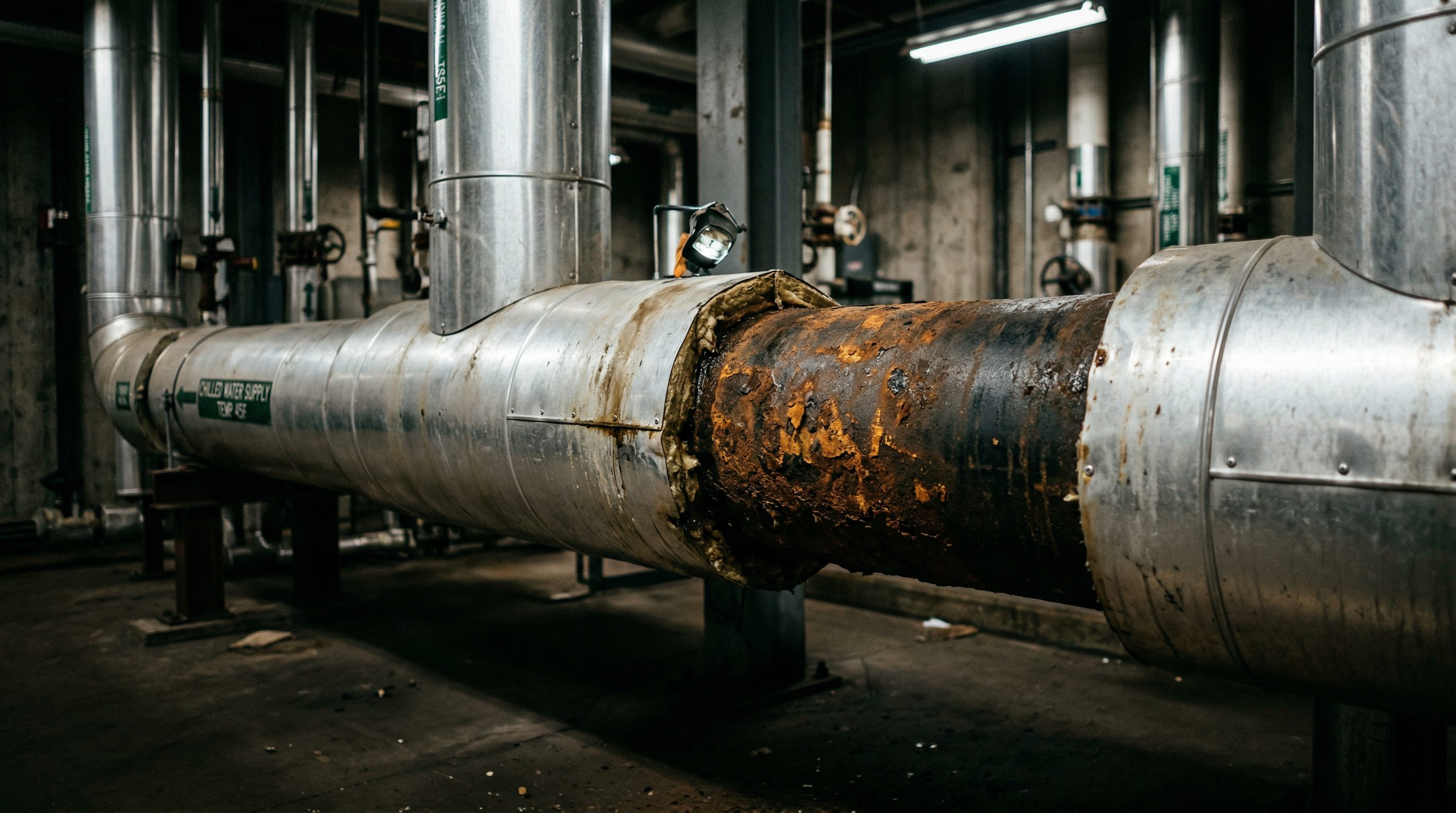
Corrosion under insulation — commonly known as CUI — is one of the most persistent and costly challenges facing industrial and commercial facilities. It develops silently beneath thermal insulation, hidden from view, and is often only discovered once significant damage has already occurred. In Ireland, where humidity, rainfall, and mild temperatures create ideal conditions for moisture ingress, CUI is a particularly serious concern for data centres, pharmaceutical plants, food processing facilities, and mechanical services across the country.
What Is Corrosion Under Insulation?
CUI refers to the external corrosion of piping, vessels, and equipment that occurs beneath thermal insulation or fireproofing materials. When moisture finds its way into the insulation system — whether through rainwater, condensation, process leaks, or inadequate sealing — it becomes trapped against the metal surface. The insulation itself prevents the moisture from evaporating, creating a constantly wet environment that accelerates corrosion far beyond what the same pipe would experience if left uninsulated.
According to research published by Aspen Aerogels, the presence of water-absorbing insulation can accelerate corrosion rates up to 20 times faster than on an uninsulated system. The insulation that is meant to protect the pipework can, paradoxically, become the very thing that destroys it — when moisture control fails.
The Scale of the Problem
The financial impact of CUI is staggering. Industry estimates suggest that CUI accounts for 40–60% of all pipe maintenance costs in insulated systems, with approximately 10% of an entire facility's maintenance budget going towards repairing CUI-related damage. The global cost of corrosion is estimated at $2.2 trillion per year, representing around 3% of global GDP. Within Europe specifically, CUI in ageing pipelines has accounted for 20% of major oil and gas incidents reported within the EU since 1984, and 60% of pipe failures in North Sea assets are attributed to CUI.
Studies from operating facilities have shown that up to 60% of insulation that has been in service for more than 10 years will contain corrosive moisture — regardless of the jacketing and sealants used during installation. Water, eventually, finds a way in.
CUI accounts for 40–60% of pipe maintenance costs in insulated systems. Up to 60% of insulation in service for 10+ years contains corrosive moisture.
Why Ireland Is Particularly Vulnerable
Ireland's maritime climate creates near-perfect conditions for CUI. The combination of high relative humidity (averaging 75–90% year-round), frequent rainfall (Dublin receives rain on approximately 150 days per year), mild temperatures that keep moisture in liquid form, and salt-laden air along the coast all contribute to an environment where moisture ingress into insulation systems is almost inevitable over time.
CUI is most aggressive on carbon steel operating between -12°C and 175°C, and on austenitic and duplex stainless steels between 50°C and 175°C. Ireland's temperate climate means that outdoor pipework, rooftop equipment, and exposed mechanical plant are almost always operating within this critical temperature range — unlike facilities in hotter, drier climates where insulation can dry out naturally.
The sectors most at risk in Ireland include:
- Data centres — extensive chilled water pipework, cooling systems, and mechanical plant rooms with complex insulation requirements
- Pharmaceutical plants — process piping operating across a wide range of temperatures, often with stringent cleanliness requirements that make CUI particularly problematic
- Food and beverage facilities — refrigeration lines, process piping, and washdown environments where moisture is constantly present
- Healthcare facilities — LTHW, chilled water, and steam distribution systems
- Commercial buildings — mechanical plant rooms, rooftop equipment, and exposed services
The Three Causes of CUI
According to the Association for Materials Protection and Performance (AMPP), three primary factors drive CUI:
1. Moisture Intrusion
Water ingress is the single biggest cause of CUI. Rainwater, process leaks, condensation, and even wash-down water can penetrate damaged or poorly sealed insulation systems. Once trapped, that moisture initiates corrosion — particularly when contaminants such as chlorides or sulphides are present. Common entry points include failed jacketing seals, pipe supports, valve and flange locations, and any point where insulation has been damaged or poorly reinstated after maintenance.
2. Temperature Fluctuations
Insulated systems frequently undergo thermal cycling. Temperature changes create pressure differences that draw moisture into the insulation and trap it there. These cycles accelerate corrosion, especially in coastal or humid climates like Ireland's. Systems that regularly shut down and restart — or that operate near the dew point — are particularly vulnerable.
3. Material Selection and Installation Quality
Certain insulation materials retain more water or break down faster over time. Jacketing systems can crack, degrade, or fail if not correctly installed and sealed. Choosing the wrong insulation material or failing to properly seal the cladding significantly increases the risk of CUI. Equally, insulation materials can themselves contribute to corrosion — some contain leachable chlorides, fluorides, or other compounds that become corrosive when wet.
How to Detect CUI
One of the biggest challenges with CUI is that it is, by its very nature, hidden. The insulation conceals any degradation until leaks, equipment failure, or costly shutdowns occur. Several inspection methods are available, each with different strengths:
Visual Inspection
The most basic method. Look for signs of moisture staining, bulging jacketing, rust weeping through joints, or damaged cladding. While limited in what it can detect beneath the surface, it remains the essential first line of defence.
Insulation Removal
Physically removing sections of insulation to inspect high-risk areas directly. Costly and disruptive, but provides definitive evidence of CUI. Targeted removal of insulation at vulnerable points (supports, elbows, dead legs) is a practical compromise.
Ultrasonic Testing (UT)
Measures wall thickness to detect metal loss. Requires insulation removal at test points but provides accurate quantitative data on remaining pipe wall. The industry standard for confirming CUI severity once suspect areas are identified.
Infrared Thermography
Uses thermal imaging cameras to identify wet insulation by detecting temperature anomalies. Wet insulation appears as hot spots compared to dry sections. Non-invasive and can screen large areas quickly, though it indicates moisture presence rather than corrosion directly.
Pulsed Eddy Current (PEC)
An electromagnetic technique that can measure wall thickness through insulation and weather jacketing without removal. Can penetrate up to 250mm of insulation and 100mm of steel. Effective for screening large areas on carbon steel systems.
Guided Wave Testing
Sends ultrasonic waves along the length of a pipe from a single probe position, capable of screening long sections. Effective for identifying areas of significant wall loss that warrant further investigation. Some insulation removal is needed at the probe location.
SGS Ireland, based in Naas, Co. Kildare, is one example of an inspection provider offering specialist CUI services using a combination of guided wave, real-time radiography, pulsed eddy current, and thermal imaging techniques tailored to the Irish market.
Preventing CUI: Best Practice
Prevention is always more cost-effective than remediation. The following measures significantly reduce CUI risk:
Proper Insulation Design and Specification
Effective CUI prevention starts at the design stage. Every insulation specification should consider whether insulation is truly necessary for each section of pipework, the correct insulation material for the operating temperature and environment, moisture resistance properties (closed-cell materials like phenolic foam, Foamglas, and Armaflex inherently resist moisture absorption better than open-cell alternatives), and the cladding and jacketing system to provide weather protection.
Quality Aluminium Cladding and Sealing
The aluminium or stainless steel jacketing over the insulation is the primary weather barrier. Proper installation is critical — all joints must be sealed, overlaps should shed water (lapped in the direction of flow), and fixings must be secure without puncturing the weather barrier. Particular attention should be paid to complex areas such as valves, flanges, pipe supports, and changes in direction.
Protective Coatings
Applying a suitable protective coating to the pipe surface before insulation is installed provides a secondary line of defence. Even if moisture reaches the metal surface, a properly specified coating system can prevent or significantly slow the corrosion process. Coatings rated for immersion or CUI-prone environments should be specified.
Regular Inspection and Maintenance
A risk-based inspection programme is essential. High-risk areas — such as equipment supports, pipe hangers, dead legs, areas exposed to weather, and systems that undergo regular thermal cycling — should be inspected more frequently. Any damaged jacketing should be repaired promptly, as even small breaches can allow significant moisture ingress over time.
Correct Installation by Experienced Tradespeople
Perhaps the most overlooked factor in CUI prevention is the quality of the original insulation installation. Poorly fitted insulation, inadequately sealed joints, and substandard cladding work create the conditions for CUI from day one. This is precisely why experienced insulation engineers — tradespeople with decades of hands-on experience who understand the consequences of shortcuts — are so important to the long-term integrity of any insulation system.
At Alumitherm Assist, our founder brings over 40 years of personal hands-on experience, and we employ only insulation engineers with 20+ years each. That depth of expertise means every installation is done right — correctly specified, properly sealed, and built to last. We understand CUI because we have spent decades dealing with the consequences of poor insulation work.
Looking Ahead
CUI will remain one of the most significant challenges for insulated systems in Ireland's climate. However, the combination of proper material selection, quality installation, effective cladding and sealing, and a proactive inspection regime can dramatically reduce the risk. As industries such as data centres and pharmaceuticals continue to grow in Ireland, the demand for high-quality thermal insulation work — and the skilled tradespeople who can deliver it — will only increase.
If you are concerned about CUI on your facility, or if you are specifying insulation for a new project and want to ensure it is done properly from the outset, we would be happy to discuss your requirements.
Concerned About CUI on Your Facility?
Get in touch with our experienced team to discuss your insulation requirements. We provide specialist thermal insulation and cladding services across Dublin and the greater Leinster area.
Contact Us