
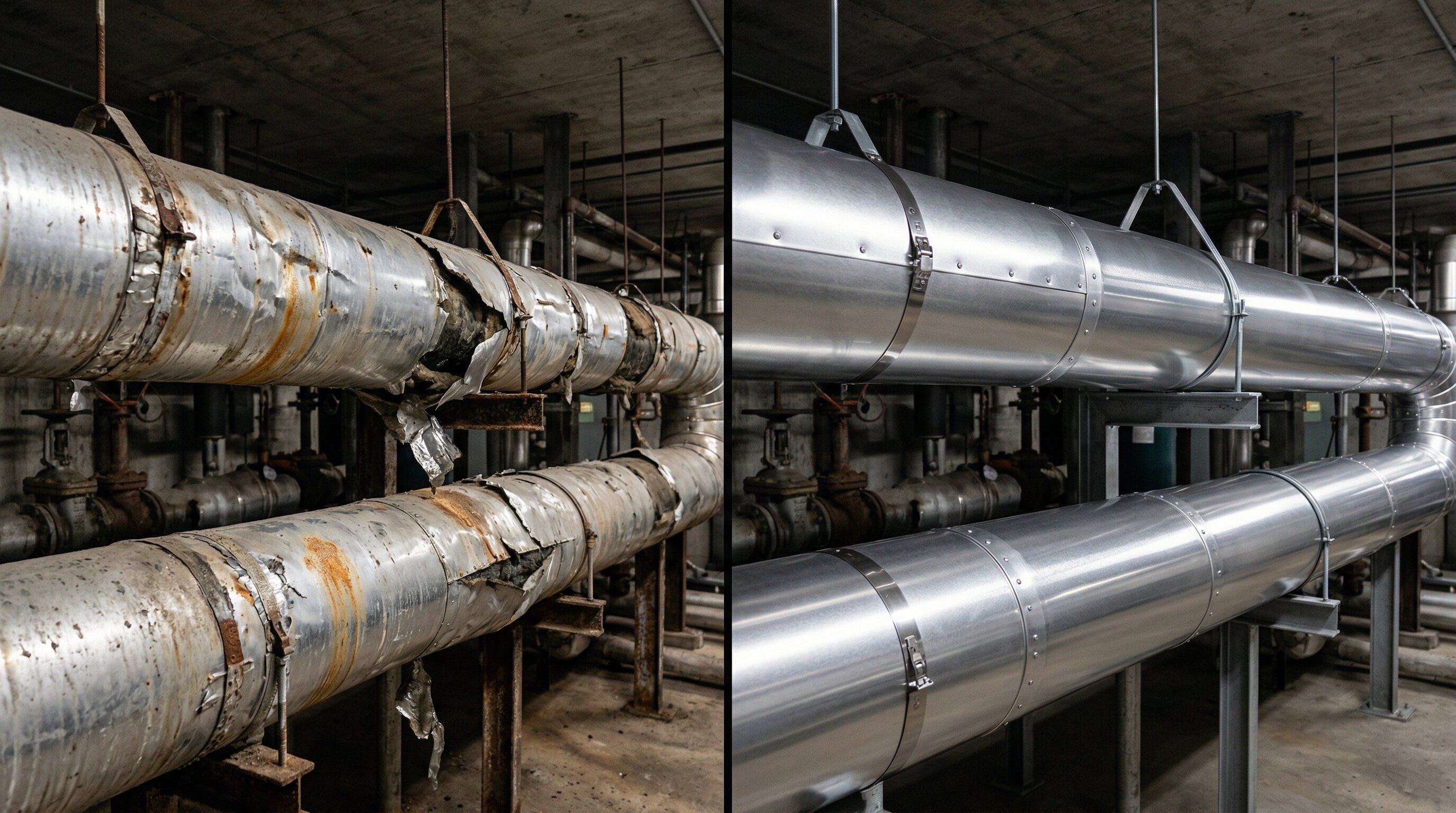
There is a common assumption in the construction industry that insulation is a straightforward job — that anyone can wrap a pipe or clad a duct. After more than 40 years working in thermal insulation across industrial and commercial sectors in the UK, Ireland, and major projects overseas, our founder has seen first-hand how wrong that assumption can be. A newly insulated plant room can look perfect on handover day, with neat aluminium cladding gleaming under the lights, and yet be harbouring installation failures that will cost the building owner tens of thousands of euro over the system's lifetime. The insulation that is supposed to save energy, prevent condensation, and protect pipework can, when installed incorrectly, actually accelerate the very problems it was meant to prevent.
Common Installation Failures
Experienced insulation engineers can walk into a plant room and identify problems within minutes — not because they have special equipment, but because they have seen these same failures repeated on site after site, year after year. These are the issues that come up most frequently.
Gaps Between Insulation Sections
This is perhaps the single most damaging installation failure, and it is remarkably common. When preformed pipe insulation sections are not butted tightly together, or when gaps open up as pipework expands during operation, the exposed pipe surface loses heat at a dramatically higher rate than the insulated sections. According to analysis published by the National Insulation Association (NIA), the heat loss from a bare pipe surface can be approximately 20 times greater than from the same surface properly insulated. That means even small gaps have an outsized impact on total system performance.
If gaps between insulation sections account for just 2% of the total pipe surface area, the overall heat loss from that system can increase by approximately 40%. On a 36-inch preformed section, 2% equates to a gap of less than 20mm per joint — barely visible, but enormously costly over the life of the installation.
Compression of Insulation Material
Insulation works by trapping air within its fibrous or cellular structure. When insulation is compressed — by forcing oversized material into a tight space, standing on it during installation, or over-tightening cladding fixings — those air pockets are squeezed out and thermal resistance drops. Compressing a fibreglass batt designed for a 150mm cavity into a 90mm space can reduce its total R-value by over 30%. The insulation is still physically present, but it is no longer performing as specified — and once the cladding goes on, this problem is completely invisible.
Wrong Material for the Application
Not all insulation materials are interchangeable. One of the most common mistakes is using mineral wool or fibreglass on cold systems — chilled water lines, refrigeration pipework — without a properly sealed vapour barrier. On cold systems, the insulation must prevent warm, moisture-laden ambient air from reaching the cold pipe surface. Without an effective vapour barrier, condensation forms within the insulation, saturating it over time. Wet insulation has almost no thermal value, and the trapped moisture creates ideal conditions for corrosion under insulation (CUI).
Poor Cladding Seals Allowing Moisture Ingress
The aluminium or stainless steel cladding over the insulation is not decorative — it is the primary weather barrier. When joints are not properly overlapped, end caps are missing, or sealant is skipped at penetrations, moisture finds its way in. In Ireland's climate, where rain falls on roughly 150 days per year, poorly sealed cladding is an invitation for moisture ingress. Once water is inside the insulation, the cladding that was meant to keep it out now prevents it from evaporating — leading directly to CUI, a problem we have covered in detail here.
Insulation Missing at Supports, Hangers, and Brackets
Pipe supports and hangers are some of the most critical — and most frequently neglected — points in any insulation system. Research published by the National Institute of Standards and Technology (NIST) found that heat loss at pipe supports can be approximately 17 times greater than at sections without supports. For typical support spacings, more than half of total heat loss from insulated pipes can occur at the support locations alone. Yet on site after site, we see supports left completely bare or with token insulation that does not properly address the thermal bridge.
Insulation Reinstated Poorly After Maintenance
Maintenance teams regularly need to access valves, flanges, and equipment beneath insulation. Once the work is complete, the insulation should be properly reinstated — but in practice, it often is not. Insulation gets stuffed back roughly, cladding is left loose or fastened with cable ties, and vapour barriers are punctured without being resealed. Over time, a system that was originally well-insulated can deteriorate significantly through the accumulation of poor reinstatement.
Incorrect Thickness for the Operating Temperature
Insulation thickness is not arbitrary. It is calculated based on operating temperature, ambient conditions, the material's thermal conductivity, and the desired outcome — whether energy conservation, condensation prevention, or personnel protection. Using insulation that is too thin means the system will never achieve its design performance, regardless of how well it is installed.
The Financial Impact
The consequences of poor insulation installation are not abstract. They translate directly into costs that building owners and facilities managers bear for years — sometimes decades — after the original work was completed.
Increased Energy Costs
Heating and cooling systems that are poorly insulated work harder to maintain the required temperatures. Boilers run longer, chillers cycle more frequently, and energy bills climb accordingly. On a large commercial or industrial installation — a data centre cooling system, a pharmaceutical process plant, a hospital heating network — even a modest percentage increase in heat loss translates to thousands of euro per year in additional energy costs.
Premature Equipment Failure
Condensation caused by inadequate insulation on cold systems leads to corrosion of pipework, valves, and fittings. Moisture ingress through poorly sealed cladding accelerates CUI on hot systems. Both result in premature equipment failure — pipe replacements, valve renewals, and in severe cases, complete system shutdowns. The cost of replacing corroded pipework in an operating facility far exceeds the cost of insulating it properly in the first place.
Remedial Work Costs
When insulation has to be stripped and redone, the costs compound rapidly. The original insulation must be removed and disposed of, the pipe surface inspected and treated, new insulation procured and installed, and new cladding fitted. In an operating facility, this work often has to be done in confined spaces, at height, around live services, and out of hours. As a general rule, remedial insulation work costs two to three times what it would have cost to do the job correctly the first time.
Programme Delays on New Builds
On new construction projects, insulation that fails quality inspection has to be redone before the system can be commissioned. This creates programme delays that affect not just the insulation subcontractor but every trade that follows. In Ireland's current construction market, where data centre and pharmaceutical projects operate on extremely tight programmes, insulation rework can push back commissioning dates and trigger liquidated damages.
Compliance Failures
Building regulations, energy performance standards, and project specifications all set minimum requirements for insulation performance. Insulation that is incorrectly installed may fail to meet these requirements at commissioning — adding cost and delay at the worst possible point in the project programme.
Why Poor Installation Happens
Understanding why installation quality suffers is the first step towards preventing it. The causes are systemic, not random, and they tend to reinforce one another.
Inexperienced Workers
Thermal insulation is a skilled trade. Fitting insulation properly around complex pipework, valves, flanges, and equipment requires years of hands-on experience. Understanding which materials to use, how to achieve a proper vapour seal on cold systems, and how to detail cladding to shed water rather than trap it — these are not skills that can be picked up in a few weeks. Yet the industry frequently deploys workers with minimal training, particularly when demand outstrips the available skilled workforce.
Lowest-Price Tendering
The practice of awarding insulation subcontracts to the lowest bidder is one of the primary drivers of poor quality. When price is the only criterion, there is enormous pressure to cut labour quality, installation time, and attention to detail. A contractor bidding at the lowest possible price cannot afford to employ experienced tradespeople or carry out meaningful quality checks. Research into public construction procurement has found that rework and defects can add up to 30% of total project costs — the initial saving is illusory.
Rushed Programmes
Insulation is typically one of the later trades on a construction programme, squeezed into whatever time remains before commissioning. When programmes are compressed, shortcuts become inevitable: gaps are left rather than properly closed, complex areas are insulated roughly rather than carefully detailed, and quality checks are skipped in favour of speed.
Lack of Inspection and Quality Checks
Insulation is one of the least-inspected elements on most construction projects. Once the cladding is on, the insulation beneath it is invisible — and unlike electrical or mechanical systems, it is not functionally tested at commissioning. Without meaningful inspection during installation, poor workmanship goes undetected. By the time problems manifest as energy waste, condensation, or corrosion, the cladding has to come off and the remedial cost multiplier applies.
The Case for Experienced Tradespeople
There is a persistent misconception that insulation installation is unskilled work — that it is simply a matter of wrapping material around pipes and covering it with metal. Nothing could be further from the truth.
A competent insulation engineer understands thermal conductivity, vapour pressure, dew point calculations, and the behaviour of different materials across a range of temperatures. They know how to detail insulation at complex junctions — where pipes change direction, where branches connect, where supports penetrate the system — without creating gaps, thermal bridges, or moisture paths. They understand that cladding is not just a cover but a critical weather barrier, and they know how to lap, seal, and fix it to last.
This knowledge comes from years of working on live sites, seeing what happens when shortcuts are taken. It is the difference between insulation that performs as designed for 25 years and insulation that begins failing from day one. In sectors like data centres, pharmaceuticals, healthcare, and food and beverage — where system performance and reliability are non-negotiable — the quality of the insulation installation is fundamental to the operation of the facility.
What M&E Contractors Should Look For
If you are a mechanical or electrical contractor appointing an insulation subcontractor, the following criteria will help distinguish experienced, quality-focused firms from those likely to cause problems:
- Workforce experience — Ask about the people who will actually be on site, not the directors or the estimator. A company that employs tradespeople with 15–20+ years of hands-on experience will deliver fundamentally different work from one relying on recently trained operatives.
- Track record on similar projects — Data centres, pharmaceutical plants, and healthcare facilities each have specific requirements that general insulation contractors may not be familiar with.
- Quality management — Do they carry out their own inspections before inviting you to inspect? Do they photograph installations before cladding is applied?
- Material knowledge — Can they discuss the pros and cons of different insulation materials for your application? A subcontractor who installs whatever they are given without question is a risk.
- Approach to complex areas — Ask how they handle valves, flanges, pipe supports, and equipment connections. A firm with a clear methodology for these areas will deliver better long-term performance.
- Willingness to push back — The best subcontractors will raise concerns about inadequate specifications or programmes that do not allow proper installation time. A firm that simply says yes to everything is not acting in your interest.
Price should be a factor, but not the dominant one. The difference between an experienced subcontractor and a low-cost alternative is typically a fraction of the cost of remedial work when the cheaper option fails.
At Alumitherm Assist, we only employ insulation engineers with 20+ years of hands-on experience, led by a founder with over 40 years in the trade. We take on complex projects that other established companies cannot handle — because our team has the depth of knowledge to get them right. Every installation is done once, done properly, and built to last. That is not a sales pitch. It is simply how we work.
Getting It Right the First Time
The message is straightforward: insulation quality matters, and it matters from day one. The cost of poor installation extends well beyond energy waste — to equipment failure, remedial work, programme delays, and compliance failures. These costs are almost always greater than the saving achieved by cutting corners on the original installation.
For building owners and M&E contractors alike, the decision comes down to a simple question: do you want to pay for the job once, or two or three times?
Need Insulation Done Right the First Time?
Get in touch with our experienced team to discuss your insulation requirements. We provide specialist thermal insulation and cladding services across Dublin and the greater Leinster area.
Contact Us