
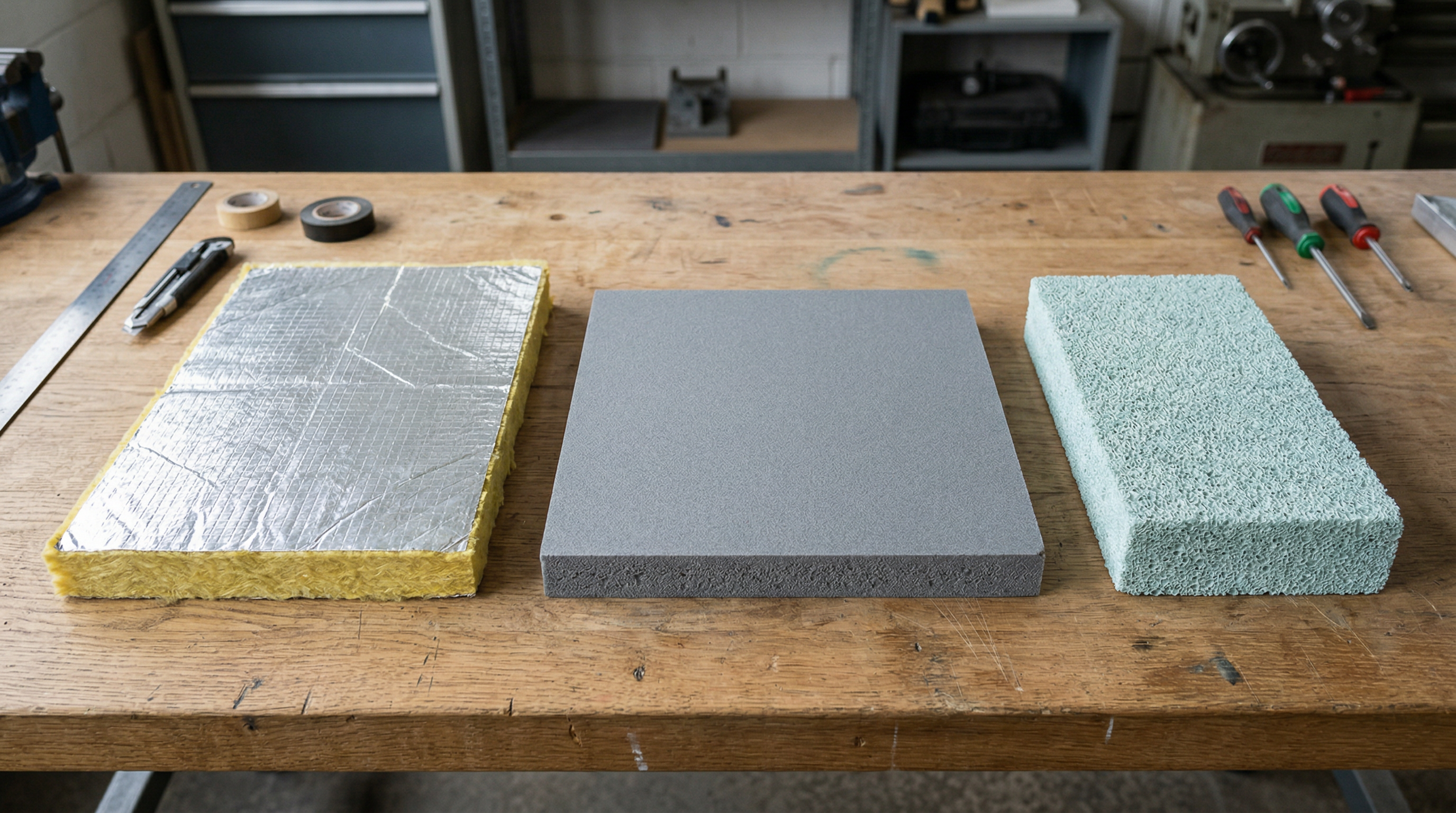
Choosing the right insulation material is one of the most consequential decisions in any industrial or commercial mechanical installation. Get it right and the system performs efficiently for decades — low energy loss, no condensation problems, no corrosion, minimal maintenance. Get it wrong and you are looking at premature failure, moisture damage, energy waste, and costly remediation work. After more than 40 years of installing, specifying, and troubleshooting insulation systems across data centres, pharmaceutical plants, hospitals, food processing facilities, and commercial buildings in the UK, Ireland, and major industrial projects overseas, we have worked with every major insulation material on the market. This article sets out what we have learned — not from data sheets, but from handling these materials day in, day out, on real projects.
Why Material Selection Matters
It is tempting to think of insulation as a commodity — something you simply wrap around a pipe to stop heat escaping. In reality, each insulation material has a distinct set of properties that make it suited to certain applications and entirely wrong for others. Thermal conductivity is only part of the picture. You also need to consider fire performance, moisture resistance, compressive strength, temperature range, available thickness, cost, and how the material actually behaves when installed in the field.
In Ireland's climate, moisture resistance deserves particular attention. With relative humidity averaging 75–90% year-round and rain falling on roughly 150 days per year in Dublin alone, any insulation system that cannot manage moisture — either through its own material properties or through proper cladding and vapour sealing — is going to develop problems. We see the consequences of poor material selection regularly: saturated mineral wool on chilled water systems that should have been insulated with Armaflex, phenolic foam specified for high-temperature steam lines it was never designed to handle, and open-cell insulation used on cold systems without adequate vapour barriers.
The right material in the right application, installed correctly, makes all the difference.
Mineral Wool (Rock Wool and Glass Wool)
Mineral wool is the workhorse of the insulation industry and for good reason. It is the material we install most frequently across all sectors, and it remains the most versatile and cost-effective option for the majority of industrial and commercial applications.
Key Properties
- Thermal conductivity: approximately 0.034–0.040 W/mK at ambient temperature, depending on density and product type
- Fire resistance: non-combustible, classified A1 under EN 13501-1 — withstands temperatures exceeding 1,000°C without melting or contributing to fire spread
- Acoustic performance: excellent sound absorption, which makes it particularly valuable in plant rooms and mechanical risers
- Temperature range: suitable for applications from approximately -50°C up to 700°C (rock wool) or 450°C (glass wool)
- Moisture behaviour: open-cell structure means it can absorb moisture if not properly protected — always installed with aluminium foil facing and sealed aluminium cladding
When We Use It
Mineral wool is our default choice for general pipework insulation, ductwork, vessels, and plant room applications operating at above-ambient temperatures. It is the standard material for LTHW and MTHW heating systems, domestic hot water services, and general mechanical plant insulation in commercial buildings. In industrial settings, rock wool handles the higher temperature ranges found on process piping and equipment.
The critical point with mineral wool is that it must always be installed with proper aluminium foil backing and sealed aluminium cladding. Mineral wool on its own provides no moisture barrier. In Ireland's damp climate, unprotected mineral wool will absorb moisture, lose its insulating value, and create conditions for corrosion under insulation. Every mineral wool installation we carry out includes properly sealed aluminium jacketing — no exceptions.
Practical Considerations
Mineral wool is easy to work with, widely available, and competitively priced. It can be cut and shaped on site to fit around complex geometries — pipe bends, tees, valves, and flanges. For most standard mechanical insulation work in Ireland, mineral wool with aluminium cladding offers the best balance of performance, cost, and practicality.
Phenolic Foam
Phenolic foam is the high-performance option. When thermal efficiency is the priority — or when space is constrained — phenolic foam delivers insulation performance that no other commonly available material can match.
Key Properties
- Thermal conductivity: approximately 0.018–0.023 W/mK — the lowest of any readily available insulation material
- Space efficiency: achieves the same insulation value as mineral wool at roughly 47% less thickness, which is a significant advantage in tight spaces
- Fire performance: thermoset material that does not melt or drip in a fire, with very low flame spread and exceptionally low smoke emission — limited primarily to carbon dioxide and carbon monoxide
- Moisture resistance: closed-cell structure provides inherent resistance to moisture absorption
- Temperature range: typically rated from -180°C to +120°C
When We Use It
Phenolic foam comes into its own on projects where space is at a premium. In modern commercial buildings and data centres, ceiling voids, risers, and service corridors are often tightly packed with competing services. Where 40mm of mineral wool would be needed, 20–25mm of phenolic foam can achieve the same thermal performance. That difference matters when you are trying to fit insulated pipework into a congested ceiling void alongside cable trays, fire suppression systems, and ventilation ductwork.
We also specify phenolic foam for projects with demanding energy performance requirements. Its superior thermal conductivity means less heat loss per unit thickness, which can be the difference between meeting and missing building energy targets. For low-temperature hot water systems and chilled water pipework in commercial buildings, phenolic foam with sealed aluminium cladding is an excellent choice.
Practical Considerations
Phenolic foam is more expensive than mineral wool per metre, but the reduced thickness means less cladding material and sometimes faster installation. It is a rigid material that holds its shape well, though it is more brittle than mineral wool and requires careful handling — it does not tolerate being thrown around on site. When cutting phenolic foam, the dust can be irritating, so proper PPE is essential. Its temperature limit of around 120°C means it is not suitable for steam systems or high-temperature process piping.
Foamglas (Cellular Glass)
Foamglas is in a class of its own when it comes to moisture resistance. Made entirely from hermetically sealed glass cells, it is the only insulation material that is completely impervious to water and water vapour — zero absorption, full stop.
Key Properties
- Thermal conductivity: approximately 0.036–0.050 W/mK at typical operating temperatures, comparable to mineral wool
- Moisture resistance: completely waterproof and vapour-tight — water cannot penetrate or circulate within the material
- Fire performance: non-combustible, classified A1 under ISO 1182 and EN 13501-1
- Compressive strength: excellent — suitable for load-bearing applications without creep or deformation
- Temperature range: -269°C to +482°C, making it suitable for both cryogenic and high-temperature applications
- Chemical resistance: resistant to organic solvents, acids, and aggressive atmospheres
When We Use It
Foamglas is the material of choice for cold and below-ambient systems where moisture control is absolutely critical. On chilled water pipework, cold stores, refrigeration systems, and cryogenic applications, the consequences of moisture ingress into the insulation are severe — ice formation, loss of thermal performance, and corrosion under insulation. Foamglas eliminates that risk entirely because moisture simply cannot enter the material.
We also specify Foamglas in pharmaceutical clean room environments, where the insulation must not harbour moisture, support microbial growth, or release fibres or particles. Its inorganic glass composition means it is completely inert — it will not rot, support mould, or degrade over time. For underground pipework and applications where the insulation may be in contact with soil or standing water, Foamglas provides reliable long-term performance where other materials would fail.
Practical Considerations
Foamglas is a premium product with a price to match. It is heavier than most alternatives and rigid, which means it requires more precision during installation — you cannot compress it to fit around awkward shapes the way you can with mineral wool. It is also more fragile on impact than mineral wool, so it must be handled carefully on site. Despite these considerations, for the applications where it is needed, nothing else provides the same level of moisture protection. We have seen Foamglas installations that are still performing perfectly after decades in service.
Armaflex (Flexible Elastomeric Foam)
Armaflex is a closed-cell, flexible elastomeric foam that has become the standard material for insulating chilled water and refrigeration systems, particularly in data centres and commercial cooling applications.
Key Properties
- Thermal conductivity: approximately 0.033–0.038 W/mK
- Built-in vapour barrier: the closed-cell structure provides an integrated vapour barrier throughout the full thickness of the material — not just a surface facing
- Flexibility: can be wrapped around pipes, bends, and fittings without cutting complex shapes
- Condensation control: specifically engineered to prevent condensation on cold surfaces
- Fibre-free: does not release dust or fibres, making it suitable for sensitive environments
- Temperature range: typically -50°C to +110°C
When We Use It
Armaflex is our go-to material for chilled water systems in data centres. The cooling infrastructure in a modern data centre — chilled water piping, refrigerant lines, chillers, cooling distribution units, air handlers — all operates below ambient temperature, which means condensation is a constant threat. Armaflex's built-in vapour barrier and closed-cell structure make it the ideal solution. It prevents condensation forming on cold pipe surfaces, protects against corrosion under insulation, and does not release particles that could contaminate sensitive IT equipment.
We also use Armaflex extensively on pharmaceutical process cooling systems, food and beverage refrigeration, and any cold pipework application where condensation control is the primary concern. In these environments, the consequences of condensation — dripping water onto servers, contamination of clean rooms, slip hazards on production floors — go far beyond simple energy loss.
Practical Considerations
Armaflex is straightforward to install. The flexible material wraps easily around pipework and can be glued in place with contact adhesive, creating a continuous sealed envelope. For straight pipe runs, pre-slit tubes speed up installation considerably. The material is light, clean to handle, and produces no irritating fibres. It is not suitable for high-temperature applications — anything above about 110°C requires a different material — and it does not have the compressive strength needed for load-bearing applications. But for cold systems, it is hard to beat.
Calcium Silicate
Calcium silicate is the specialist high-temperature material. Where other insulation materials reach their limits, calcium silicate keeps going — maintaining its structural integrity and insulating performance at temperatures that would destroy most alternatives.
Key Properties
- Temperature capability: continuous service up to 650°C (Type I) and 927°C (Type II), with some formulations rated even higher
- Compressive strength: exceeds 100 psi — the highest of any non-structural high-temperature insulation material
- Fire performance: non-combustible with zero flame spread and zero smoke development
- Structural integrity: maintains its form and performance under sustained high temperatures, thermal cycling, and mechanical vibration
- Corrosion inhibition: modern formulations are manufactured to inhibit corrosion under insulation on both carbon steel and stainless steel
When We Use It
Calcium silicate is specified for high-temperature steam systems, boiler pipework, process piping in refineries and chemical plants, and any application where operating temperatures exceed the capabilities of mineral wool or phenolic foam. In Ireland, we encounter it most frequently on steam distribution mains in pharmaceutical manufacturing plants, hospital steam systems, and industrial process facilities.
Its exceptional compressive strength also makes it the right choice for applications subject to physical abuse — pipe runs in areas with foot traffic or mechanical handling, and locations where the insulation needs to support its own weight and the weight of the cladding over long vertical runs.
Practical Considerations
Calcium silicate is a rigid, pre-formed material that is cut and shaped to fit during installation. It is heavier than mineral wool and requires careful handling to avoid breakage. While it is inherently moisture-resistant to some degree, it can absorb water if exposed — and while it will dry out without structural damage, wet calcium silicate obviously provides less insulation. As with mineral wool, proper aluminium cladding and sealing are essential to keep moisture out.
Mineral Wool: 0.034–0.040 W/mK | Non-combustible (A1) | Up to 700°C | Best for: general pipework, ductwork, vessels
Phenolic Foam: 0.018–0.023 W/mK | Low flame spread | Up to 120°C | Best for: space-constrained, high-performance requirements
Foamglas: 0.036–0.050 W/mK | Non-combustible (A1) | -269°C to +482°C | Best for: cold systems, moisture-critical applications
Armaflex: 0.033–0.038 W/mK | Built-in vapour barrier | -50°C to +110°C | Best for: chilled water, data centres, refrigeration
Calcium Silicate: ~0.055 W/mK | Non-combustible | Up to 650–927°C | Best for: steam systems, high-temperature process piping
Choosing the Right Material: Real-World Decision Making
Data sheets and thermal conductivity figures are useful, but they only tell part of the story. After four decades in this trade, the decisions we make about material selection are guided as much by practical experience as by published specifications. Here is how we actually approach it on site.
Start With the Operating Temperature
Temperature is the first filter. If the system operates above 120°C, phenolic foam and Armaflex are off the table. Above 700°C, you are into calcium silicate territory. Below ambient temperature — chilled water, refrigeration, cold stores — you need a material with either an inherent vapour barrier (Armaflex, Foamglas) or a meticulously sealed external vapour barrier system.
Then Consider the Environment
A plant room in a Dublin commercial building is a very different environment from an outdoor pipe rack at a pharmaceutical facility in Ringaskiddy. Indoor applications with controlled environments are forgiving — mineral wool with aluminium cladding will perform reliably for decades. Outdoor and exposed applications in Ireland's climate demand more attention to moisture management. Areas with high humidity, washdown environments, or potential water exposure push the specification towards closed-cell materials like Foamglas or Armaflex.
Factor in Space Constraints
Modern buildings are getting tighter. The ceiling voids in a new data centre or hospital can be extraordinarily congested. When you are fighting for every millimetre of clearance, phenolic foam's ability to deliver the same insulation value at roughly half the thickness of mineral wool becomes a genuine advantage — not a nice-to-have, but the difference between a workable installation and one that simply will not fit.
Think About the Full Lifecycle
The cheapest material up front is not always the cheapest over 20 or 30 years. Mineral wool is the most affordable option for general applications, and for most standard mechanical services work it is the right choice. But on a chilled water system in a data centre, specifying mineral wool instead of Armaflex to save money on day one is a false economy — the condensation problems, maintenance calls, and eventual replacement will cost far more than the price difference. Similarly, specifying standard insulation on a cold store when Foamglas would eliminate moisture problems for the life of the installation is a decision that pays for itself many times over.
Never Underestimate Installation Quality
The best insulation material in the world will fail if it is installed badly. Gaps in coverage, unsealed joints, missing vapour barriers, poorly fitted cladding — these are the things that cause insulation systems to underperform, regardless of which material was specified. This is why we believe the quality of the people doing the installation matters as much as the quality of the materials. An experienced insulation engineer who understands the properties and limitations of each material will produce a result that lasts. A crew that treats insulation as an afterthought will create problems that someone else has to fix.
At Alumitherm Assist, we do not have a preferred supplier or a single material we push on every project. Our founder brings over 40 years of hands-on experience, and every one of our insulation engineers has 20+ years in the trade. That experience means we know which material belongs on which application — and just as importantly, we know when a specification needs to be questioned. We have seen too many projects where the wrong material was specified because someone looked at the data sheet without considering the real-world conditions. When we take on a project, we make sure the material is right for the job before a single piece of insulation goes on.
A Note on Irish Conditions
Ireland's maritime climate adds a layer of complexity to insulation material selection that is often underestimated by specifiers more familiar with continental European or North American conditions. Our consistently high humidity, frequent rainfall, mild winters that keep moisture in liquid form rather than freezing it, and salt-laden coastal air all influence how insulation systems perform over time.
For outdoor applications in Ireland, moisture management is not optional — it is the primary design consideration. Closed-cell materials, properly sealed vapour barriers, and high-quality aluminium cladding with sealed joints are essential. For indoor applications in controlled environments, the risks are lower, but plant rooms in older buildings can still be surprisingly damp. We assess each installation on its merits, considering the actual conditions the insulation will face — not just the design temperature and pipe diameter.
Conclusion
There is no single best insulation material. There is only the best material for a given application, environment, and set of constraints. Mineral wool remains the right choice for the majority of standard mechanical insulation work. Phenolic foam earns its place where space is tight and thermal performance is critical. Foamglas is unmatched for moisture-critical cold applications. Armaflex is the standard for chilled water and refrigeration systems. Calcium silicate handles the extreme temperatures that other materials cannot.
The skill lies in knowing which to use where — and in installing it properly so that it performs as intended for the life of the system. That is what we do.
Need Help Choosing the Right Insulation Material?
Get in touch with our experienced team to discuss your insulation requirements. We provide specialist thermal insulation and cladding services across Dublin and the greater Leinster area.
Contact Us