
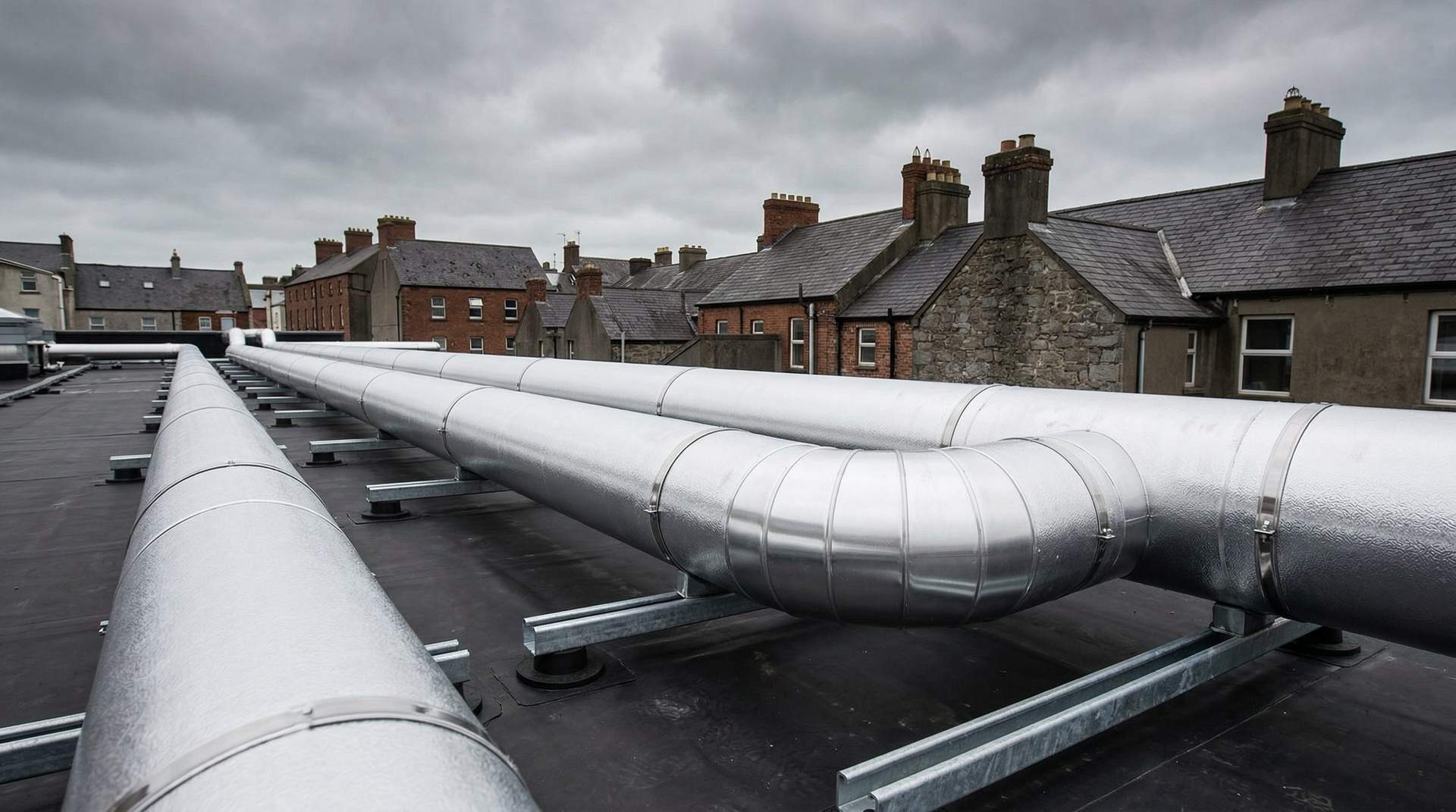
Walk across the rooftop of any large commercial building, data centre, hospital, or industrial facility in Ireland, and you will find pipework. Chilled water mains, heating flow and return lines, condenser water pipes, refrigerant lines, and sometimes steam or compressed air — all running between plant rooms, across pipe bridges, and up to rooftop air handling units, cooling towers, and condensers. This pipework is fully exposed to the Irish weather, 365 days a year. And it all needs to be insulated properly.
Rooftop pipework insulation is, in many ways, the most demanding application we encounter. The combination of constant weather exposure, temperature extremes, UV radiation, wind loading, and the practical difficulties of working at height makes rooftop insulation a genuine test of both the insulation system and the skill of the tradespeople who install it. Having spent over 40 years in the insulation trade, including countless rooftop installations across Dublin and the greater Leinster area, I can say with confidence that rooftop pipework is where shortcuts are most visible — and where they cause the most damage.
The Challenges of Rooftop Insulation in Ireland
Ireland's climate is particularly hostile to rooftop insulation systems. The challenges are multiple and relentless.
Rainfall and Moisture
Dublin receives rain on approximately 150 days per year, and relative humidity averages 75–90% throughout the year. Rooftop pipework is directly exposed to this — driving rain, pooling water on flat roof surfaces, and persistent dampness. Every joint, every seal, every termination on the insulation cladding is a potential entry point for water. Once water gets into the insulation, it is trapped against the pipe surface, and the consequences follow quickly — on hot systems, corrosion under insulation (CUI); on cold systems, loss of vapour barrier integrity and condensation problems.
Wind Exposure
Rooftops are exposed to the full force of the wind, which in Ireland's Atlantic climate can be considerable. Wind damage to insulation cladding is one of the most common problems on rooftop installations. Poorly fixed or inadequately sealed aluminium cladding can be peeled back, lifted, or torn off entirely in high winds. Once the cladding is compromised, the insulation beneath is exposed to the weather and degrades rapidly.
Wind loading must be considered when specifying and installing rooftop cladding. Fixings must be robust, joints must be overlapped correctly (lapped in the direction of prevailing weather), and the cladding system must be designed to resist uplift forces. This is not something that can be done by guesswork — it requires understanding of the specific conditions on each rooftop.
UV Degradation
Ultraviolet radiation from sunlight degrades many insulation and sealing materials over time. Elastomeric insulation (Armaflex and similar), which is widely used on chilled water systems, is particularly vulnerable to UV damage if left uncladded. UV exposure causes the material to crack, harden, and lose its thermal and vapour barrier properties — often within 12–18 months of installation if unprotected.
On internal installations, elastomeric insulation can be left uncladded (with an appropriate UV-protective coating if near windows or skylights). On rooftops, it must always be protected — either with a UV-resistant coating or, preferably, with proper aluminium or stainless steel cladding.
Temperature Extremes and Thermal Cycling
While Ireland's climate is temperate overall, rooftop conditions can be more extreme than ground level. Summer sun on a flat roof can heat surfaces to well over 60°C. Winter temperatures can drop below freezing, particularly overnight and in exposed locations. This daily and seasonal thermal cycling imposes stress on the insulation and cladding system — expansion and contraction of cladding joints, movement at pipe supports, and stress on seals and fixings.
The insulation system must accommodate this movement without losing integrity. Expansion joints in long cladding runs, flexible sealants at joints and terminations, and properly designed details at pipe supports are all essential.
Bird and Animal Damage
Birds — particularly crows and seagulls — will pull at exposed insulation and cladding edges on rooftop installations. The best defence is a well-sealed cladding system with no exposed insulation edges.
Ireland's combination of high humidity, frequent rainfall, salt-laden coastal air, and persistent wind makes rooftop pipework one of the most demanding insulation environments anywhere. The insulation and cladding system must be designed and installed to withstand these conditions for the full design life of the facility — typically 25 years or more.
Insulation Material Selection for Rooftop Pipework
The choice of insulation material for rooftop pipework depends on the system temperature and the specific requirements of the installation.
Hot Systems (Heating, LTHW, Steam)
For hot pipework on rooftops — heating flow and return, low temperature hot water (LTHW), and steam systems — the common insulation materials are:
- Phenolic foam — Light tan or buff coloured with aluminium foil outer facing. Excellent thermal performance (typically 0.021 W/mK at 10°C), closed-cell structure resisting moisture absorption, and good fire performance. One of the best choices for rooftop hot pipework where space is limited and high thermal performance is needed.
- Mineral wool — Available in pre-formed pipe sections with aluminium foil facing. Good thermal performance across a wide temperature range, non-combustible, and cost-effective. Must be properly clad and sealed on external installations to prevent moisture absorption, as mineral wool will absorb water if the cladding is breached.
- Calcium silicate — Used on high-temperature systems (typically above 250°C). Rigid, non-combustible, and durable. Less common on standard commercial rooftop installations but relevant for industrial process pipework.
Cold Systems (Chilled Water, Glycol, Refrigerant)
Cold pipework on rooftops presents a double challenge — thermal insulation to maintain system temperature and prevent heat gain, plus vapour barrier integrity to prevent condensation. The materials commonly used are:
- Closed-cell elastomeric insulation (Armaflex) — The standard choice for chilled water pipework, with an integral vapour barrier. Must be protected from UV with cladding or UV-resistant coating on external installations.
- Phenolic foam with vapour barrier — Used on larger bore cold pipework where Armaflex may not be practical. Requires a separately applied and carefully sealed vapour barrier, which must be continuous and undamaged.
- Cellular glass (Foamglas) — Completely impervious to moisture, non-combustible, and dimensionally stable. Used on critical cold systems where zero moisture absorption is essential. Heavier and more expensive than alternatives, but offers the highest level of moisture resistance.
Dual Temperature Systems
Some rooftop pipework, particularly condenser water systems, operates at different temperatures depending on the season or the operating mode. The insulation material must perform across the full temperature range, and the system design must account for potential condensation during the cold phase. This requires careful specification and, in some cases, a compromise between hot and cold insulation requirements.
Cladding: The Critical Weather Barrier
On rooftop pipework, the cladding is everything. The insulation beneath is only as good as the weather barrier protecting it. A perfectly specified and installed insulation system will fail within a few years if the cladding is inadequate.
Material Selection
The standard cladding material for rooftop insulation in Ireland is aluminium sheet — typically 0.7mm or 0.9mm gauge with a stucco-embossed finish (which disguises minor dents and scratches and provides some rigidity). For coastal locations or particularly aggressive environments, stainless steel cladding may be specified to resist salt-air corrosion.
Installation Details
The quality of the cladding installation is where the real difference lies between a rooftop insulation system that lasts 25 years and one that fails within 5. Critical details include:
- Overlapping and weather lapping — All longitudinal and circumferential joints must be overlapped, with the upper piece overlapping the lower piece so that water runs off rather than into the joint. This sounds obvious, but it is one of the most common errors on rooftop installations.
- Sealing — All joints and terminations must be sealed with an appropriate sealant. On rooftop installations, sealant is essential at every joint — unlike internal installations where some joints may rely on overlap alone.
- Fixings — Self-tapping screws or pop rivets, properly spaced and secured. Fixings must be tight enough to hold the cladding securely without being so tight that they distort the cladding or compress the insulation beneath.
- Terminations — Where insulation and cladding terminate (at equipment connections, wall penetrations, and building entries), the termination detail must prevent water from tracking back along the pipe and entering the insulation. Metal end caps, flashing, and sealant are typically required.
- Pipe supports — Pipe supports (hangers, brackets, shoes) are the Achilles heel of rooftop insulation systems. The insulation must be continuous through the support, and the cladding must be dressed around the support without creating a water entry point. This is skilled work — poorly detailed supports are one of the leading causes of CUI on rooftop pipework.
- Valves and fittings — Valves, flanges, strainers, and instruments interrupt the smooth run of the cladding system. Each fitting requires bespoke cladding fabrication — and on a rooftop, each one must be weatherproof. Removable insulation jackets are often the best solution for valves that need regular access.
Many rooftop insulation failures can be traced back to a single detail: the pipe support. If the insulation and cladding are not properly dressed around the support, water will find its way in — and once it is in, the insulation starts to fail from the inside out. Getting pipe support details right requires experience and attention to detail.
Corrosion Under Insulation on Rooftop Pipework
Corrosion under insulation (CUI) is a significant risk on rooftop pipework. The constant exposure to weather — combined with the difficulty of maintaining a perfect weather barrier indefinitely — means that some moisture ingress is almost inevitable over the design life of the system. The question is not whether moisture will eventually find its way in, but how long the insulation and cladding system can delay it, and how much damage it causes when it does.
CUI on rooftop pipework is particularly problematic because the pipework is often out of sight and uninspected for years, the weather accelerates moisture ingress, the operating temperatures are typically within the range most vulnerable to CUI (-12°C to 175°C), and repair is more difficult and expensive than internal work due to access and weather constraints.
Reducing CUI Risk on Rooftops
The best defence against CUI on rooftop pipework is a combination of:
- Quality initial installation — The cladding must be properly sealed from day one. Every joint, every termination, every support detail must be weathertight.
- Appropriate material selection — Closed-cell insulation materials that resist moisture absorption (phenolic foam, Foamglas) offer better long-term CUI resistance than open-cell alternatives.
- Protective coatings — Applying a corrosion-inhibiting coating to the pipe surface beneath the insulation provides a secondary defence if moisture does eventually penetrate.
- Regular inspection and maintenance — Rooftop insulation should be inspected at least annually, with particular attention to cladding joints, pipe supports, terminations, and any areas showing signs of damage or deterioration.
Practical Considerations for Rooftop Installation
Beyond the technical challenges of materials and cladding, there are significant practical considerations that affect rooftop insulation work.
Working at Height
All rooftop insulation work requires compliance with the Safety, Health and Welfare at Work (Construction) Regulations 2013. This includes proper access arrangements (scaffolding, MEWP platforms, or guardrail systems), edge protection, and operatives trained in working at height. On flat roofs, the main hazard is often the roof edge — particularly when carrying bulky insulation materials that obstruct the operative's view of the roof perimeter.
Weather Windows
Insulation installation on rooftops is weather-dependent. Insulation materials — particularly mineral wool and some phenolic foams — must be kept dry during installation. Cladding sealing is more effective when applied in dry conditions. And it is neither safe nor practical to work on an exposed rooftop in high winds or heavy rain.
This means that rooftop insulation work must be programmed with weather in mind. In Ireland, the best months for rooftop work are typically April through October, though work can be carried out year-round with appropriate planning and weather monitoring. The key is to have enough flexibility in the programme to accommodate weather delays without impacting the overall project.
Material Handling and Storage
Getting insulation materials to roof level requires planning — cranes or hoists on larger projects, manual handling on smaller ones. Once on the roof, materials must be stored properly — protected from rain, secured against wind, and kept off the roof membrane. Insulation materials left exposed in Irish weather can be ruined within hours.
Coordination with Other Trades
Rooftop insulation must be coordinated with roofing contractors (where pipes penetrate the roof membrane), electrical contractors (for trace heating), and the mechanical contractor responsible for the pipework. Poor coordination can result in insulation being installed too early (before testing), too late (after access is closed off), or in conflict with other trades' work.
Common Failures on Rooftop Insulation
In my experience, the most common failures on rooftop insulation systems are:
- Wind-damaged cladding — Cladding that was not properly fixed or sealed, and has been lifted or torn by wind. Once the cladding is breached, the insulation beneath degrades rapidly.
- Failed sealant — Sealant that has dried out, cracked, or been washed out of joints over time. Sealant on rooftop installations has a limited life and should be inspected and renewed as part of a maintenance programme.
- Poorly detailed pipe supports — Support brackets that were not properly insulated or clad, allowing water to enter the insulation system at the support location.
- UV-degraded elastomeric insulation — Armaflex or similar that was installed on external pipework without UV protection. Within 12–18 months, the material cracks and disintegrates.
- Missing insulation — Sections of pipework that were never insulated in the first place, or where insulation was removed for maintenance access and never reinstated.
- Inadequate thickness — Insulation that was specified for internal conditions but installed on external pipework without accounting for the additional heat loss (or heat gain) due to wind chill and weather exposure.
Every one of these failures is avoidable with proper specification, quality installation, and a reasonable maintenance regime.
Maintenance and Inspection
Rooftop insulation systems should not be installed and forgotten. A simple annual inspection programme — checking cladding joints, pipe supports, terminations, and looking for signs of wind damage, UV degradation, or moisture staining — can prevent minor issues from becoming major problems. Prompt repair of any damage found is far cheaper than dealing with the consequences of unchecked deterioration. A small cladding repair today can prevent a major CUI problem — and a pipe replacement — in a few years' time.
At Alumitherm Assist, we have decades of experience insulating rooftop pipework across Dublin, Kildare, Wicklow, Meath, and the greater Leinster area. Our founder has over 40 years of personal hands-on experience, and every member of our team has a minimum of 20 years in the trade. We understand the specific challenges of external insulation work in Ireland's climate — and we take particular care with the cladding details, support work, and sealing that make the difference between a system that lasts and one that fails.
Getting It Right From the Start
The key message for main contractors, M&E managers, and consulting engineers specifying rooftop insulation is this: rooftop pipework requires more attention, not less, than internal pipework. The specification should account for the harsher conditions — potentially thicker insulation to compensate for wind chill, robust cladding with proper fixings and sealing, and detailed requirements for support work, terminations, and fittings.
And critically, the installation should be carried out by experienced tradespeople who understand the demands of rooftop work. A tradesperson who does excellent work inside a warm, dry plant room may not have the knowledge or experience to produce the same quality on an exposed rooftop in February. Rooftop insulation and cladding work is a specialist skill, and choosing the right subcontractor is essential.
If you have a project with significant rooftop pipework insulation requirements, or if you have concerns about the condition of existing rooftop insulation on your facility, we would be happy to discuss your requirements.
Need Rooftop Pipework Insulated Properly?
Get in touch with our experienced team to discuss your rooftop insulation requirements. We provide specialist thermal insulation and sheet metal cladding services across Dublin and the greater Leinster area.
Contact Us