
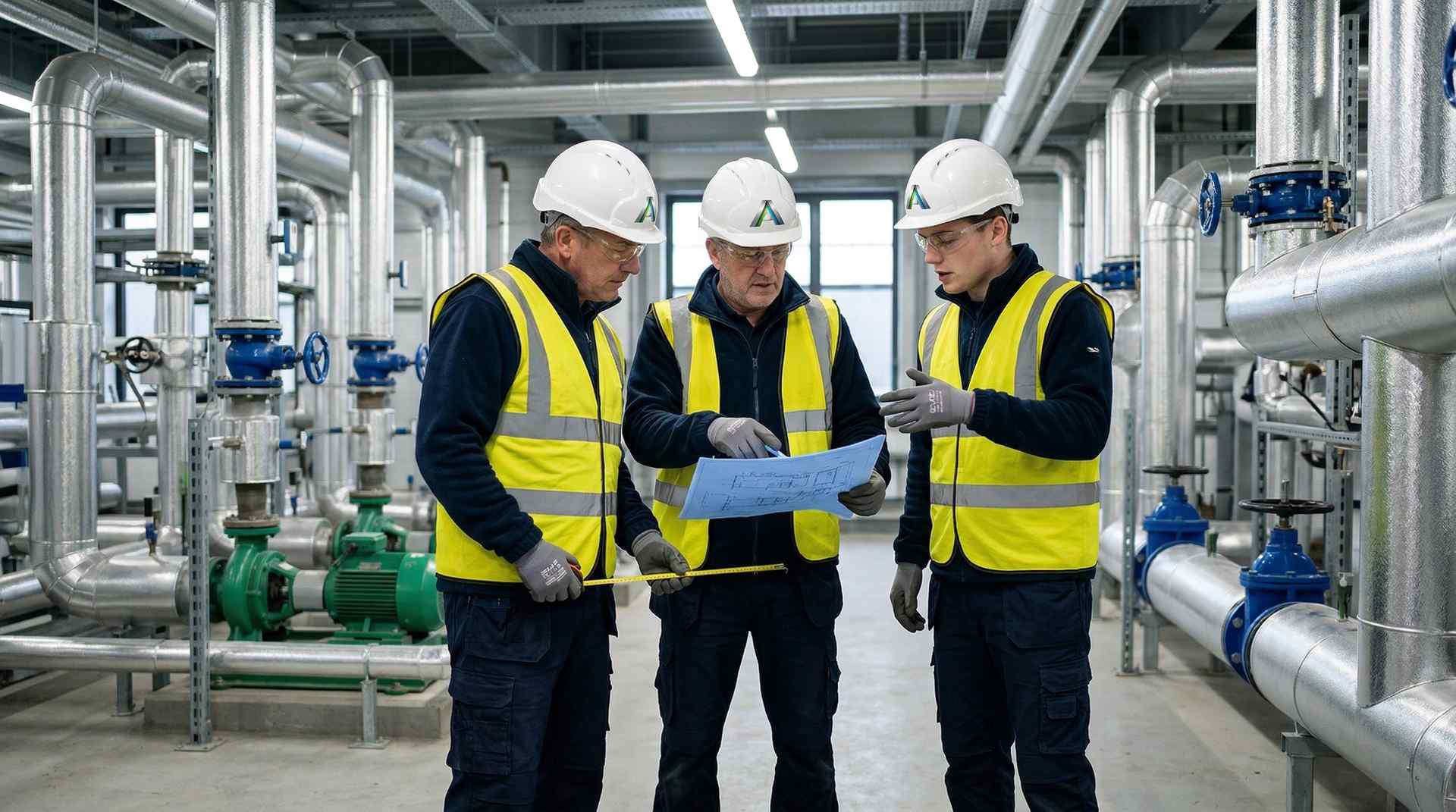
Thermal insulation is one of those trades that tends to be appointed late, priced aggressively, and expected to fit around everyone else's programme. That is understandable — on a busy M&E project there are dozens of competing priorities, and insulation is rarely the one keeping the project manager awake at night. But it probably should be. Poorly installed insulation causes condensation damage, energy loss, noise complaints, and corrosion problems that can cost many times more than the insulation contract itself. Choosing the right insulation subcontractor is not just about finding the cheapest price — it is about protecting the long-term performance of the entire mechanical installation.
Having spent over 40 years working as an insulation engineer and now running Alumitherm Assist, I have seen the consequences of poor appointments from both sides — as the tradesperson called in to fix someone else's work, and as the subcontractor trying to deliver quality on a project where the wrong decisions were made during procurement. This article is intended as a practical guide for main contractors, M&E managers, and building services consultants who want to get this decision right.
Why the Choice of Insulation Subcontractor Matters
Insulation is not a commodity trade. The difference between a well-installed system and a poor one is enormous — in terms of thermal performance, condensation prevention, fire compliance, acoustic performance, and the long-term durability of the pipework and ductwork it protects. A poorly installed insulation system can lead to:
- Condensation and moisture damage — Incorrectly installed vapour barriers on chilled water systems lead to sweating pipes, dripping ceilings, mould growth, and damage to building fabric and equipment below.
- Energy waste — Gaps, compression, and missing sections of insulation can reduce the thermal performance of a system by 20–40%, directly increasing the building's energy consumption and operating costs.
- Corrosion — Poor cladding and sealing practices accelerate corrosion under insulation (CUI), particularly on external pipework and in Ireland's damp climate.
- Noise complaints — Inadequate acoustic insulation in plant rooms and risers can result in noise transfer to occupied spaces, leading to complaints and costly remedial work.
- Programme delays — An unreliable subcontractor who cannot resource the job properly will hold up handover, commissioning, and ceiling closures.
The insulation package on a typical commercial or industrial M&E project might represent 3–5% of the overall mechanical contract value. But the consequences of getting it wrong can account for a far larger share of the snagging, defects, and remedial costs.
Experience: The Single Most Important Factor
If there is one piece of advice in this article that matters more than any other, it is this: look at the experience of the people who will actually be on site doing the work. Not the company's years in business. Not the managing director's CV. The tradespeople. The insulation engineers who will be cutting, fitting, sealing, and cladding your pipework and ductwork every day.
Insulation is a highly skilled manual trade. It requires an understanding of thermal dynamics, material behaviour, vapour barrier principles, specification interpretation, and the practical realities of working around completed mechanical services in tight spaces. This knowledge takes decades to develop properly.
At Alumitherm Assist, every insulation engineer we employ has a minimum of 20 years of hands-on trade experience. That is not a marketing claim — it is the foundation of everything we do. We work across Dublin, Kildare, Wicklow, Meath, and the greater Leinster area, and we have built our reputation on the quality of our people.
Questions to Ask About Experience
- How many years of trade experience do your insulation engineers have?
- Have they worked on projects similar to this one — in terms of scale, sector, and specification?
- Will the same team be on site throughout the project, or will you rotate personnel?
- Can you provide references from recent projects of a similar nature?
- What training and upskilling do your tradespeople receive?
Understanding of Specifications
A good insulation subcontractor should be able to read and interpret insulation specifications confidently. This sounds obvious, but in practice many insulation contractors simply price off quantities and drawings without fully understanding the specification requirements — particularly around vapour barriers, material grades, thickness requirements, and cladding finishes.
The specification is where the consulting engineer sets out exactly what is required: the insulation materials, thicknesses, vapour barrier requirements, cladding types, and finish standards. A subcontractor who does not fully understand the specification will either:
- Price incorrectly (leading to disputes later)
- Install incorrectly (leading to defects)
- Substitute materials without understanding the consequences
- Miss critical requirements such as fire ratings or acoustic performance
When evaluating a potential subcontractor, ask them to walk you through the specification. If they cannot explain the vapour barrier requirements, the difference between the various insulation materials specified, or why certain areas require stainless steel cladding rather than aluminium, that should raise concerns.
Labour-Only Flexibility
The labour-only subcontracting model is increasingly common in the Irish insulation industry, and for good reason. Under this arrangement, the main contractor or M&E contractor procures the insulation materials directly (or through a nominated supplier), and the insulation subcontractor provides the skilled labour to install them.
This model offers several advantages:
- Material cost transparency — The main contractor sees the actual material costs and can negotiate directly with suppliers.
- Specification control — Materials are procured to match the specification exactly, reducing the risk of substitution.
- Flexibility — The main contractor can adjust material quantities and phasing as the project progresses.
- Reduced risk — If the insulation subcontractor is providing labour only, the main contractor retains control of the material supply chain.
Not all insulation subcontractors are willing or set up to work on a labour-only basis. Some prefer to supply and install as a single package. When choosing a subcontractor, consider whether the labour-only model might be more appropriate for your project, and confirm that the subcontractor you are considering can work comfortably in that arrangement.
Programme Compliance and Resourcing
Insulation work is inherently dependent on other trades. You cannot insulate pipework that has not been installed, pressure-tested, and signed off. You cannot clad ductwork that is still being modified. This means insulation subcontractors need to be flexible and responsive — able to mobilise quickly when areas become available, and willing to work around the realities of a live construction site.
The questions to ask here are practical:
- How many operatives can you deploy on this project? — Make sure they can resource the job adequately, even during busy periods.
- Can you increase labour at short notice? — Projects often need to accelerate towards handover. Can the subcontractor scale up?
- How do you manage phasing and access? — A good subcontractor will plan their work around ceiling closures, commissioning dates, and other trades' programmes without being constantly chased.
- What is your track record on programme delivery? — Ask for specific examples and references.
Be cautious of subcontractors who quote very low prices and then cannot resource the job when the time comes. In the insulation trade, there is a direct relationship between the price, the quality of the operatives, and the reliability of the programme. If a price looks too good to be true, it usually is.
Quality of Finish
The finish quality of insulation work matters — not just aesthetically, but functionally. Neatly fitted insulation with properly sealed joints and well-dressed cladding is not just about appearance; it reflects the care and attention that has been applied to the entire installation. If the visible finish is poor, the hidden elements — vapour barriers, joint seals, support details — are likely to be poor as well.
In high-profile environments such as exposed services in commercial buildings, data centres, and pharmaceutical clean rooms, the finish standard is often specified explicitly. But even in concealed plant rooms and risers, a professional standard of workmanship should be expected.
When evaluating a subcontractor's finish quality:
- Visit a current or recent project — There is no substitute for seeing the work in person. Look at the neatness of joints, the alignment of cladding, the sealing at penetrations, and the overall presentation.
- Ask for photographs — A reputable subcontractor will have a portfolio of completed work.
- Check the cladding details — Sheet metal cladding is where craftsmanship is most visible. Look at how elbows, tees, and terminations are handled.
Health and Safety
Any subcontractor working on a construction site in Ireland must comply with the Safety, Health and Welfare at Work (Construction) Regulations 2013, and hold current Safe Pass certification for all operatives. Beyond the basics, look for:
- A written safety statement specific to their operations
- Risk assessments and method statements (RAMS) prepared for the specific project
- Evidence of manual handling training — insulation work involves handling bulky materials in confined and elevated positions
- Proper PPE — in Ireland and the UK, standard site PPE typically includes navy or dark-coloured workwear, hard hats, safety boots, and hi-vis where required
- Experience with working at height — much insulation work takes place on scaffolding, MEWP platforms, and ladder access
Insurance and Compliance
Confirm that the subcontractor holds adequate insurance cover, including:
- Employer's liability insurance — Mandatory for any employer
- Public liability insurance — Typically a minimum of €6.5 million for construction work in Ireland
- Professional indemnity insurance — Relevant if the subcontractor is providing any design input or specification advice
Also confirm their tax compliance — a valid Tax Clearance Certificate (or C2 certificate for the construction industry) should be provided as a matter of course. Main contractors are increasingly required to verify subcontractor tax compliance under Revenue's electronic Relevant Contracts Tax (eRCT) system.
Sector Experience
Different sectors have different insulation requirements. A subcontractor who has extensive experience in commercial fit-out may not be the best choice for a pharmaceutical clean room, and vice versa. Consider whether your project requires specific sector knowledge:
- Data centres — Condensation-critical environments with extensive chilled water systems and very high quality expectations
- Pharmaceutical — GMP-compliant environments with stringent cleanliness, material traceability, and documentation requirements
- Food and beverage — Hygienic environments with specific cladding requirements and frequent washdown exposure
- Healthcare — Complex mechanical systems with acoustic, thermal, and fire insulation requirements
- Commercial offices and retail — Aesthetic finish standards, coordination with architectural elements, and NZEB compliance
Communication and Professionalism
The relationship between a main contractor and their insulation subcontractor should be a partnership, not an adversarial arrangement. Look for a subcontractor who:
- Responds to queries promptly and clearly
- Raises concerns or potential issues proactively rather than waiting for them to become problems
- Attends site meetings and coordination sessions when required
- Provides clear documentation — progress records, material certifications, quality records
- Is willing to push back professionally when a specification or programme is unrealistic, rather than simply saying yes and then failing to deliver
A subcontractor who quietly accepts an impossible programme and then delivers late is far more problematic than one who raises concerns early and works with you to find a realistic solution.
Price Is Important — But It Is Not Everything
Of course price matters. Every project has a budget, and insulation must be procured within that budget. But the cheapest price is rarely the best value. Consider the total cost of the appointment:
- Will the subcontractor complete on programme, or will delays cost you in other trades' standing time and extended preliminaries?
- Will the work be done right first time, or will you spend weeks on snagging and defects?
- Will the insulation system perform as intended for its design life, or will you face condensation, energy loss, and corrosion problems within a few years?
- Will the subcontractor be easy to work with, or will you spend disproportionate management time chasing them?
In my experience, the difference in price between a good insulation subcontractor and a cheap one is often 10–15% of the insulation package value. On a project where insulation represents 3–5% of the mechanical contract, that difference is marginal in the overall scheme of things — but the difference in outcome can be enormous.
We are a specialist labour-only insulation subcontractor based in Dublin, serving projects across Dublin, Kildare, Wicklow, Meath, and the greater Leinster area. Our founder has over 40 years of personal hands-on experience in the trade, and every member of our team has a minimum of 20 years. We do not claim to be the cheapest — but we deliver work that is done properly, on time, and to a standard that our clients are happy to put their name to.
A Practical Checklist
To summarise, here is a practical checklist for evaluating an insulation subcontractor:
- Trade experience of the operatives who will be on site (not just the company)
- Understanding of the insulation specification — can they explain it back to you?
- Ability to work on a labour-only basis if required
- Adequate resourcing and flexibility to meet your programme
- Evidence of quality workmanship — site visits, photographs, references
- Current Safe Pass, insurance, and tax clearance documentation
- Relevant sector experience for your project type
- Clear communication and a professional, collaborative approach
- A realistic price that reflects the quality and reliability you need
Choosing the right insulation subcontractor is not complicated, but it does require asking the right questions and looking beyond the bottom line on the tender return. The insulation on your project will be there for decades — it is worth taking the time to make sure it is installed by people who know what they are doing.
Looking for an Experienced Insulation Subcontractor?
Get in touch with our team to discuss your project requirements. We provide specialist thermal insulation and sheet metal cladding services across Dublin and the greater Leinster area.
Contact Us