
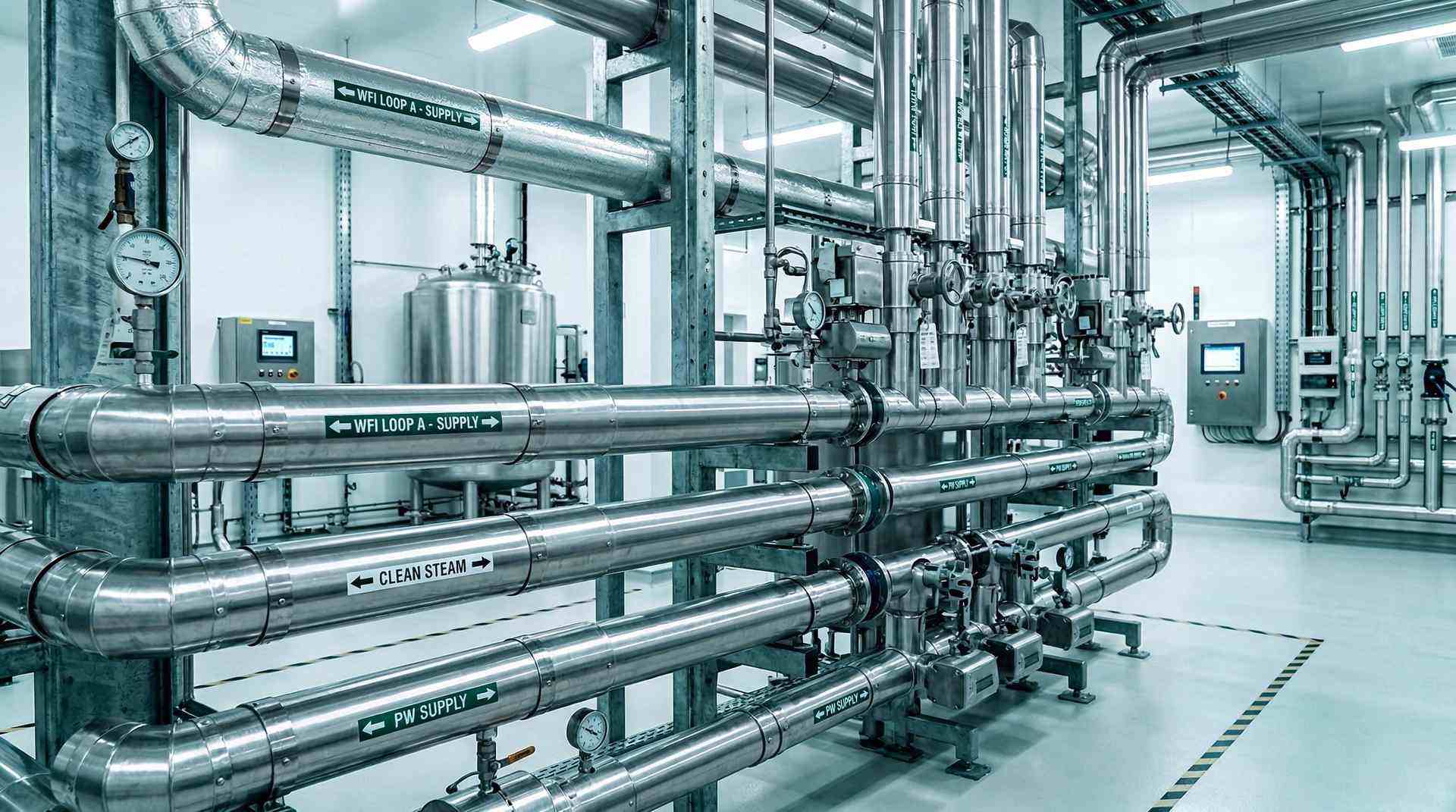
Ireland's pharmaceutical sector is one of the most important industries in the country. Nine of the world's top ten pharmaceutical companies have significant manufacturing operations here, and Ireland is the largest exporter of pharmaceuticals in Europe. With production facilities concentrated across Dublin, Cork, Limerick, Galway, and the midlands, the demand for high-quality mechanical services — including thermal insulation — is substantial and ongoing. But pharmaceutical insulation is not the same as insulating a standard commercial building or even a typical industrial facility. The requirements are more demanding, the standards are higher, and the consequences of getting it wrong are far more serious.
Over more than 40 years in the insulation trade, I have worked on pharmaceutical projects of varying scale and complexity across the UK, Ireland, and major projects overseas. This article sets out the specific insulation challenges that arise in pharma environments and what main contractors and M&E managers should be aware of when specifying and installing insulation in these facilities.
Why Pharmaceutical Insulation Is Different
The fundamental difference between insulating a pharmaceutical facility and a standard commercial or industrial building comes down to three things: cleanliness, control, and compliance. Pharmaceutical manufacturing operates under Good Manufacturing Practice (GMP) regulations — a framework that governs every aspect of production to ensure that medicines are consistently produced to the quality standards appropriate to their intended use.
For insulation work, this means:
- Cleanroom compatibility — Insulation materials and cladding must not generate or harbour particles, fibres, or contaminants that could compromise the controlled environment.
- Material traceability — Every insulation material used must be traceable, with certificates of conformity and material data sheets available for audit.
- Surface finish standards — Cladding in classified areas must be smooth, wipeable, and free from crevices, ledges, or joints that could accumulate dust or allow microbial growth.
- Documentation — Installation records, quality checks, and as-built documentation are not optional extras in pharma — they are fundamental requirements.
- Controlled site access — Working in or adjacent to classified areas requires gowning procedures, tool control, and strict adherence to site protocols.
Process Pipework Insulation
Pharmaceutical plants contain extensive networks of process pipework carrying a wide range of media at different temperatures — purified water (PW), water for injection (WFI), clean steam, process gases, chilled water, glycol, heating water, and various chemical solutions. Each system has specific insulation requirements:
Hot Systems
Clean steam systems, WFI loops, and hot purified water systems typically operate between 80°C and 150°C. These require insulation for personnel protection (to prevent burns from contact with hot surfaces), energy conservation, and process temperature maintenance. Insulation material selection must consider the operating temperature, the proximity to classified spaces, and the cladding finish required.
Phenolic foam — recognisable by its light tan or buff-coloured core with aluminium foil facing — is commonly specified for hot pipework in pharma environments due to its excellent thermal performance, low smoke and toxicity characteristics, and closed-cell structure that resists moisture absorption. For higher temperature applications, mineral wool with an aluminium foil outer facing may be specified.
Cold and Chilled Systems
Chilled water and glycol systems in pharmaceutical facilities are critical — they serve air handling units, process cooling, and temperature-controlled storage areas. The insulation challenge on cold systems is primarily about condensation prevention. In Ireland's humid climate (averaging 75–90% relative humidity year-round), any break in the vapour barrier on a chilled water system will result in condensation, which in a pharmaceutical environment is unacceptable.
Closed-cell elastomeric insulation (such as Armaflex) is widely used on chilled water systems in pharma because of its integral vapour barrier properties. For larger bore pipework or where higher performance is needed, phenolic foam with a properly sealed vapour barrier and aluminium or stainless steel cladding may be specified.
Dual Temperature Systems
Some pharmaceutical process systems cycle between hot and cold temperatures. These present particular insulation challenges — the insulation must perform across the full temperature range, and the vapour barrier and cladding system must accommodate thermal expansion and contraction without losing integrity. This requires careful material selection and, critically, experienced installation.
Cleanroom and Classified Area Requirements
Pharmaceutical manufacturing areas are classified according to the level of particulate and microbial contamination permitted. The EU GMP Annex 1 classification system defines Grade A (highest cleanliness, e.g. filling zones), Grade B (background environment for Grade A zones), Grade C, and Grade D areas, each with progressively less stringent requirements.
For insulation work in or adjacent to classified areas, the implications are significant:
Cladding Finish
In classified areas, the cladding finish must be smooth, continuous, and easy to clean. Stainless steel cladding (typically 316L grade) is the standard choice for insulated pipework in cleanroom environments. All joints must be sealed, and the finish must be free from sharp edges, exposed fasteners, or crevices that could harbour contaminants. The standard of sheet metal work required in pharma clean rooms is considerably higher than in standard industrial applications.
Fibre-Free Materials
In many pharmaceutical specifications, fibrous insulation materials are restricted or prohibited in classified areas due to the risk of fibre release. This typically means mineral wool is not permitted in or immediately adjacent to Grade A, B, or C areas. Instead, closed-cell materials such as phenolic foam, cellular glass (Foamglas), or elastomeric insulation are specified. Where mineral wool is permitted (typically in technical areas and plant rooms outside classified zones), it must be fully encapsulated with aluminium foil facing to prevent fibre migration.
Installation Cleanliness
Installing insulation in a classified area — or in a space that has been cleaned ready for classification — requires strict protocols. Cutting insulation generates dust and debris. Cladding work produces metal shavings. All of this must be controlled, contained, and cleaned up to the required standard. Experienced insulation engineers understand these requirements and plan their work accordingly — using appropriate cutting methods, containing waste, and coordinating with the cleanroom validation team.
Insulation installed in or adjacent to GMP-classified areas must be fibre-free, fully sealed, and finished to a wipeable standard. The cladding quality in a pharmaceutical clean room is fundamentally different from standard industrial work — it requires specialist skill and experience.
Material Selection for Pharma Environments
Choosing the right insulation material for a pharmaceutical facility requires consideration of several factors beyond thermal performance alone:
- Particulate generation — Will the material shed fibres or particles during installation or in service? Closed-cell materials (phenolic, Foamglas, Armaflex) are inherently safer in this regard.
- Moisture resistance — In a facility where any moisture event can compromise production, the insulation system must resist water absorption. Closed-cell materials with properly sealed vapour barriers are essential on cold systems.
- Fire performance — Pharmaceutical facilities must comply with fire regulations, and insulation materials must meet the specified reaction-to-fire classifications. Phenolic foam has excellent fire performance (typically Euroclass B-s1,d0), as does Foamglas (non-combustible, Euroclass A1).
- Chemical compatibility — In areas where chemical spills or fumes may occur, the insulation and cladding system must be compatible with the chemicals present.
- Chloride content — For insulation on stainless steel pipework (common in pharma), the chloride content of the insulation material must be controlled to prevent stress corrosion cracking. ASTM C795 sets requirements for insulation materials used on austenitic stainless steel.
- Temperature range — The material must perform across the full operating temperature range of the system, including any thermal cycling.
The Importance of Documentation and Traceability
In a GMP environment, if it is not documented, it did not happen. This principle applies fully to insulation work. The documentation requirements for pharmaceutical insulation typically include:
- Material certificates of conformity for all insulation and cladding materials
- Material safety data sheets (MSDS)
- Installation quality records — typically sign-off sheets confirming that insulation has been installed in accordance with the specification, system by system
- Inspection and test plans (ITPs) covering key hold points and witness points
- As-built records showing any deviations from the original specification
- Photographic records of completed installations, particularly at concealed or hard-to-access locations
For insulation subcontractors working on pharma projects, this documentation workload is significant. It requires a systematic approach and an understanding of why it matters — not just ticking boxes, but genuinely recording what was installed, where, and to what standard.
Coordination with Other Trades
Pharmaceutical construction projects are complex, with tight programmes and extensive coordination requirements between trades. Insulation work is typically one of the later activities on the mechanical installation sequence — after pipe installation, pressure testing, and often after the initial clean. This means insulation teams must:
- Work around completed and tested systems without causing damage
- Coordinate with cleanroom builders, who may be constructing or closing classified areas on a parallel programme
- Complete work in defined sequences that align with the commissioning and qualification programme
- Be prepared for phased access — some areas may be available early while others are still under construction
The ability to plan, communicate, and adapt to the realities of a live pharmaceutical construction site is essential. This is where experience counts — an insulation team that has worked on pharma projects before understands these dynamics and can plan accordingly.
External Pipework and Utility Services
Not all insulation in a pharmaceutical facility is inside the building. Large-bore utility pipework — chilled water mains, heating mains, steam lines, and compressed air — often runs externally between buildings, across pipe bridges, and on rooftop installations. This external pipework faces the additional challenges of weather exposure, UV degradation, wind damage, and corrosion under insulation.
For external insulation on pharmaceutical sites, proper weather cladding is essential. Aluminium cladding with sealed joints and proper flashing details is the standard approach, though stainless steel may be specified in coastal locations or particularly aggressive environments. The insulation system must be designed to shed water, and the cladding must be robust enough to withstand wind loading and physical damage over the life of the facility.
Ireland's Pharmaceutical Landscape
Ireland's pharmaceutical sector continues to grow. Major manufacturing campuses across the country are regularly expanded, upgraded, and retrofitted. New facilities are being built, and existing ones are being modified to accommodate new products and processes. This ongoing investment creates a sustained demand for insulation work — both on new-build projects and on maintenance, upgrade, and turnaround works.
The concentration of pharmaceutical manufacturing in the greater Dublin area, the midlands corridor, and the Cork region means that insulation subcontractors serving this sector need to be mobile and flexible. At Alumitherm Assist, we serve projects across Dublin, Kildare, Wicklow, Meath, and the greater Leinster area, and we have the experience to work to the standards that pharmaceutical clients expect.
Common Pharmaceutical Insulation Projects
- New facility construction — Full mechanical insulation packages covering all hot, cold, and dual-temperature systems
- Facility expansions — Extending existing insulation systems to serve new production lines or building extensions
- Retrofit and upgrade — Replacing aged or damaged insulation, upgrading insulation to current specifications, or re-cladding existing systems
- Shutdown and turnaround work — Insulation removal and reinstatement to facilitate maintenance, inspection, or modification of process systems
- Energy improvement projects — Upgrading insulation to reduce energy losses and improve the facility's environmental performance, consistent with Ireland's evolving energy regulations
At Alumitherm Assist, we understand the demands of pharmaceutical insulation. Our founder has over 40 years of personal hands-on experience, and every member of our team has a minimum of 20 years in the trade. We work as labour-only subcontractors, giving main contractors full control over material procurement while we deliver the skilled installation work to the standard that pharma projects require.
Choosing an Insulation Subcontractor for Pharma
If you are a main contractor or M&E manager appointing an insulation subcontractor for a pharmaceutical project, the standard criteria for choosing a subcontractor apply — but with additional emphasis on:
- Pharma-specific experience — Has the team worked in GMP environments before? Do they understand cleanroom protocols, gowning procedures, and documentation requirements?
- Material knowledge — Can they explain why certain materials are specified for different areas and applications within a pharma facility?
- Quality of cladding finish — Stainless steel cladding in clean rooms must be impeccable. Ask to see examples.
- Documentation capability — Can the subcontractor provide the level of documentation that the pharma client will require?
- Flexibility and reliability — Pharma programmes are demanding. Can the subcontractor mobilise and demobilise as required, and can they be trusted to work independently in sensitive areas?
The insulation work on a pharmaceutical facility is often a small percentage of the overall project cost, but it plays a critical role in the performance, compliance, and longevity of the mechanical installation. Getting it right requires specialist knowledge, experienced tradespeople, and a genuine understanding of what the pharmaceutical industry demands.
If you are planning an insulation package for a pharmaceutical project and would like to discuss your requirements, we would be happy to help.
Planning Insulation for a Pharmaceutical Project?
Get in touch with our experienced team to discuss your insulation requirements. We provide specialist thermal insulation and sheet metal cladding services across Dublin and the greater Leinster area.
Contact Us